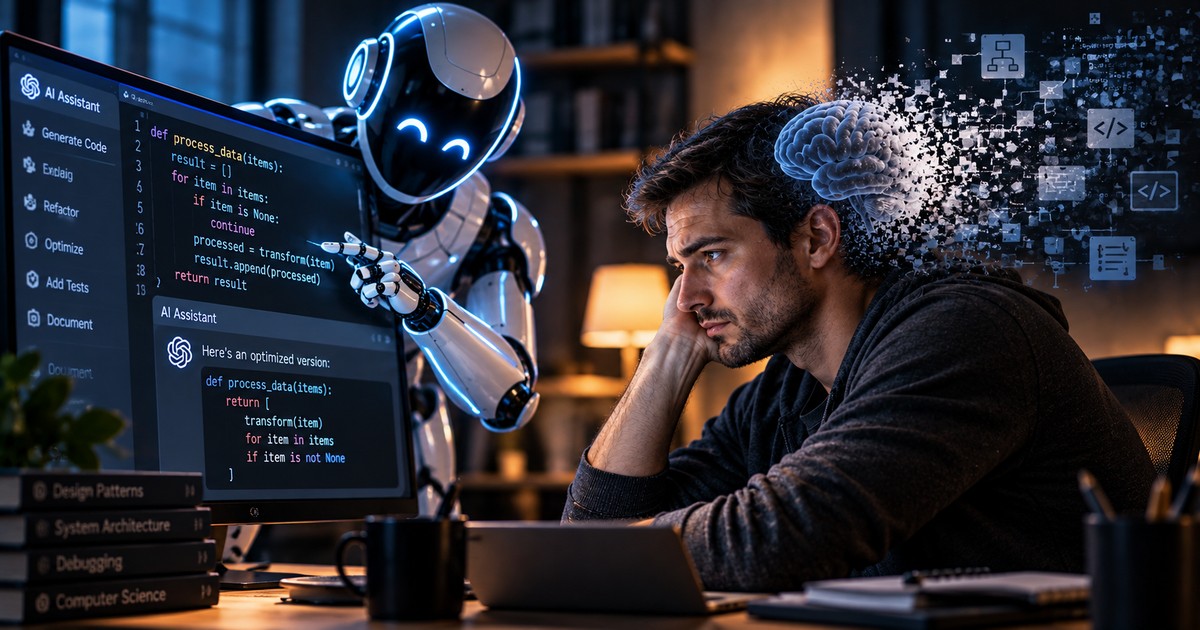
AI can write code faster than most engineers. But what happens to the engineer who gradually loses the ability to write, understand, and troubleshoot it without assistance?
Software engineering has always been a profession built on abstraction. Assembly gave way to higher-level languages. Manual memory management became increasingly automated. Frameworks eliminated repetitive work, and cloud platforms removed much of the burden of managing infrastructure.
Each advancement allowed engineers to spend less time on mechanical tasks and more time solving complex problems.
Artificial intelligence represents another leap in that progression. But there is an important distinction between previous generations of development tools and today’s AI coding assistants.
Traditional tools automated the execution of an engineer’s decisions. AI increasingly makes those decisions on the engineer’s behalf.
That distinction introduces a problem the industry has barely begun to confront: the gradual erosion of technical competence among engineers who have transitioned from writing code to prompting machines to write it.
The danger is not that AI will become too capable. It is that the engineers responsible for its output may become progressively less capable of understanding what it produces.
From Engineering to Prompting
Consider the traditional development process.
An engineer receives a requirement, evaluates possible approaches, designs a solution, writes code, encounters errors, investigates those errors, and eventually produces something functional.
Along the way, the engineer develops an increasingly sophisticated understanding of the system.
A failed compilation reveals something about language syntax. A race condition teaches concurrency. A memory leak forces an investigation into resource management. A difficult debugging session exposes architectural assumptions that might otherwise have remained invisible.
These experiences are not incidental inconveniences.
They are how technical expertise develops.
Now consider the AI-assisted alternative.
The engineer describes a requirement, receives an implementation, and asks the AI to correct whatever fails.
When an exception appears, the engineer copies it into the prompt. When a test fails, the engineer asks the model to fix the test or the implementation. When performance suffers, the engineer requests an optimization.
Eventually, the application works.
But what did the engineer actually learn?
Perhaps a great deal, if they actively investigated the generated code and understood the changes.
Perhaps almost nothing, if they simply accepted each iteration.
The resulting application may be identical, but the engineers who produced it have undergone very different learning experiences.
One has developed technical competence. The other has developed proficiency in operating an AI assistant.
Those are not interchangeable skills.
Cognitive Offloading and the Disappearing Mental Model
Psychologists use the term cognitive offloading to describe transferring mental work to external tools or systems.
We use calculators instead of performing arithmetic mentally. We rely on GPS rather than remembering routes. We store telephone numbers in our phones rather than committing them to memory.
There is nothing inherently wrong with cognitive offloading. It allows people to reserve limited mental resources for other activities.
The problem emerges when the external tool replaces a cognitive activity that must be practiced to maintain proficiency.
Software engineering depends heavily on internal mental models.
An experienced engineer understands how components interact, how data moves through an application, where failures are likely to occur, and which assumptions might break under unusual conditions.
These mental models are developed through repeated exposure to problems, mistakes, investigation, and correction.
When AI handles those activities, the engineer can lose opportunities to develop and reinforce that understanding.
The immediate result is increased productivity.
The long-term risk is declining independent capability.
An engineer may become exceptionally effective at producing code while simultaneously becoming less capable of explaining how that code works.
This creates an uncomfortable paradox:
The more productive an engineer appears with AI, the less visible their underlying technical competence may become.
The Illusion of Competence
One of the most dangerous characteristics of AI-generated code is that it frequently looks correct.
It is well formatted. Variables have sensible names. Functions are logically organized. Comments explain the apparent intent.
The output resembles something a competent engineer would write.
That appearance can create a false sense of understanding.
Reading a completed solution and recognizing its structure is substantially easier than producing that solution independently.
An engineer may review an AI-generated function and believe they understand it because every individual line appears reasonable.
But ask that same engineer to reproduce the function without assistance, explain its edge cases, or modify its behavior under unfamiliar conditions, and the apparent understanding may disappear.
This is the difference between recognition and recall.
Recognition is identifying something familiar when it is presented.
Recall requires retrieving and applying knowledge without being shown the answer.
Engineering requires both.
AI makes recognition easy while potentially allowing recall and independent problem-solving to deteriorate through disuse.
The engineer becomes increasingly comfortable evaluating completed solutions and increasingly uncomfortable constructing them.
Over time, this can produce a professional who understands code primarily when someone—or something—has already written it.
Debugging Is Where Engineers Are Made
There is a reason experienced engineers frequently remember difficult debugging sessions more vividly than successful implementations.
Debugging forces the brain to construct and test explanations.
Why did the application behave differently in production?
Why does the function work with one dataset but fail with another?
Why does a network connection succeed intermittently?
Why does a seemingly harmless dependency update break an unrelated component?
Solving these problems requires more than knowing syntax.
It requires hypothesis formation, experimentation, causal reasoning, and an understanding of the underlying system.
AI can now perform much of this work.
An engineer can paste an error message into an assistant and receive a plausible diagnosis, often accompanied by corrected code.
This is enormously convenient.
It also eliminates one of the most valuable learning opportunities in software engineering when the engineer accepts the correction without understanding the failure.
The problem is cumulative.
An engineer who avoids debugging today misses knowledge that would have helped diagnose tomorrow’s problem.
Tomorrow’s problem becomes more difficult, increasing the temptation to rely on AI again.
The cycle reinforces itself.
Eventually, the engineer may no longer possess the troubleshooting skills necessary to independently validate the assistant’s explanation.
At that point, AI is no longer merely accelerating the engineer.
It is compensating for a capability the engineer has allowed to deteriorate.
The Automation Paradox
This phenomenon is not unique to software development.
Automation has long created a paradox in professions that depend on specialized human expertise.
As automated systems become more reliable, operators spend less time performing routine tasks. Their manual skills receive less practice.
Yet when automation fails, those same operators are expected to intervene in precisely the situations that are too unusual or complicated for the automated system to handle.
The human becomes responsible for the hardest problems while receiving progressively less experience solving ordinary ones.
Software engineering is particularly vulnerable to this dynamic.
AI assistants are exceptionally useful for routine implementations, common programming patterns, and familiar troubleshooting scenarios.
But production systems eventually encounter circumstances that fall outside those patterns.
An unusual concurrency defect. A subtle security vulnerability. An unexpected interaction between dependencies. A failure involving infrastructure, application logic, and external services simultaneously.
These are situations in which an engineer needs a strong internal understanding of the system.
If years of AI dependence have weakened that understanding, the engineer may be least prepared at the moment human expertise is most important.
The organization has gained development speed while quietly accumulating operational risk.
The Junior Engineer Problem
The consequences may be particularly significant for engineers entering the profession.
Senior engineers developed much of their expertise before AI coding assistants became commonplace.
They spent years writing implementations, reading documentation, investigating failures, and developing intuition through repetition.
Junior engineers entering the industry today have access to tools that can eliminate much of that process.
A beginner can generate a functioning API, build a frontend, configure authentication, and deploy an application without fully understanding the underlying technologies.
That capability is remarkable.
But producing a working application is not the same as becoming a software engineer.
Historically, junior developers gained experience through relatively simple assignments. They wrote repetitive code, fixed minor defects, and gradually developed the knowledge necessary to handle more complex responsibilities.
AI increasingly performs those introductory tasks.
This raises an important question:
If junior engineers no longer perform the work through which previous generations developed expertise, where will the next generation of senior engineers come from?
An engineer cannot become experienced merely by supervising the output of a system that already possesses the patterns they have never learned.
Experience requires participation.
AI can accelerate that participation, but it can also replace it.
The distinction depends on how the technology is used.
When Code Review Becomes Theater
Organizations frequently respond to concerns about AI-generated code by requiring human review.
That sounds reasonable.
But meaningful code review requires the reviewer to possess enough technical knowledge to identify defects, challenge assumptions, and recognize inappropriate design decisions.
A reviewer who has become dependent on AI may lack those capabilities.
The result can be a process in which one AI system generates code, another AI system reviews it, and a human approves the result.
The human remains formally accountable, but their participation may contribute little independent technical judgment.
This is especially concerning when the generated code involves security-sensitive functionality.
Authentication, authorization, cryptography, input validation, and infrastructure configuration can contain vulnerabilities that are not obvious from superficial inspection.
Code can compile successfully, pass ordinary tests, and still contain serious defects.
If the engineer cannot independently reason about the implementation, the review process becomes little more than an approval mechanism.
The presence of a human in the workflow does not guarantee meaningful human oversight.
The Productivity Metrics Are Misleading
Organizations naturally measure engineering productivity through observable outputs.
Features delivered. Tickets completed. Pull requests merged. Development time reduced.
AI can improve all of these metrics.
But they do not necessarily measure the health of an engineering organization.
Consider two teams.
The first uses AI aggressively and delivers substantially more code. Its engineers rarely write implementations manually and increasingly rely on AI to diagnose problems.
The second also uses AI but requires engineers to understand generated implementations, maintain architectural ownership, and investigate significant failures themselves.
Both teams may produce similar results in the short term.
Their long-term technical resilience could be very different.
The first team may accumulate systems that nobody fully understands.
The second may preserve the expertise necessary to maintain and evolve those systems.
Traditional productivity metrics may fail to reveal that distinction until something goes wrong.
The danger is that management interprets increasing output as evidence of increasing engineering capability.
Those two things can move in opposite directions.
The Dependency Becomes Invisible
Perhaps the most concerning stage of AI dependence occurs when engineers stop recognizing that their capabilities have changed.
Initially, an engineer knows they are using AI to accelerate tasks they could perform independently.
Later, they begin using AI for tasks they could probably perform but would rather avoid.
Eventually, they encounter tasks they can no longer perform confidently without assistance.
The transition is gradual.
There is no obvious moment when productivity enhancement becomes dependency.
An engineer who once wrote complex SQL queries from memory may eventually struggle to construct a basic join without prompting.
Someone who previously understood asynchronous programming may begin relying on generated implementations without reasoning through execution order.
A developer who once diagnosed exceptions through stack traces and source inspection may reflexively submit every error to an assistant.
These are examples of potential skill deterioration, not inevitable outcomes for every AI user.
But the underlying mechanism is familiar: abilities that are not exercised become less accessible.
The engineer may still possess considerable conceptual knowledge, yet their practical fluency has declined.
And because AI continues producing successful results, there may be little external pressure to reverse the trend.
AI Is Not the Enemy
None of this means engineers should abandon AI.
That would be an equally misguided response.
AI coding assistants can eliminate repetitive work, accelerate prototyping, explain unfamiliar technologies, generate tests, and help engineers explore alternative implementations.
They can also serve as valuable educational tools.
An engineer who asks AI to explain a difficult concept, challenges its assumptions, and then independently implements the solution may learn faster than someone working without assistance.
The important distinction is whether AI is supporting the engineer’s reasoning or replacing it.
Using AI to generate boilerplate is different from delegating architectural decisions that the engineer cannot evaluate.
Using AI to suggest debugging hypotheses is different from blindly accepting its diagnosis.
Using AI to explain an unfamiliar algorithm is different from incorporating that algorithm into production without understanding it.
The technology itself does not determine whether cognitive decline occurs.
The engineer’s relationship with the technology does.
Preserving the Engineer Behind the Prompt
The solution is not to impose arbitrary restrictions on AI usage or insist that every line of code be written manually.
It is to preserve the activities that develop and maintain engineering competence.
Engineers should remain capable of explaining the systems they build, identifying the assumptions behind generated implementations, and troubleshooting failures without automatically delegating every investigative step.
They should periodically solve problems without AI assistance, particularly in areas central to their professional responsibilities.
They should understand why generated code works, not merely observe that it works.
And organizations should evaluate engineering competence separately from AI-assisted output.
A developer who produces ten times as much code but cannot independently diagnose a production failure has not necessarily become ten times more valuable.
The same principle applies to experienced engineers.
Decades of accumulated expertise do not make someone immune to skill deterioration.
An engineer who spent twenty years developing strong technical instincts can gradually weaken those instincts by outsourcing the reasoning that once kept them sharp.
Expertise is not a permanent possession.
It must be exercised.
The Engineer Who Can No Longer Engineer
The ultimate risk of AI-assisted development is not that machines will write better code than humans.
They already outperform many developers at certain well-defined tasks.
The more consequential possibility is that the industry will produce an increasing number of professionals whose apparent engineering capabilities depend almost entirely on continuous access to AI.
They will be able to generate applications, implement features, and resolve common errors at remarkable speed.
But remove the assistant, introduce an unfamiliar failure, or demand a rigorous explanation of the underlying system, and the limits of their independent expertise may become apparent.
This does not mean every engineer who uses AI will experience cognitive decline. Deliberate use can improve learning and expand technical capability.
But engineers who consistently delegate the cognitive work of engineering should not assume their skills will remain unchanged.
The brain adapts to what it is repeatedly asked to do.
If an engineer spends years constructing solutions, investigating failures, and reasoning through complex systems, those abilities are reinforced.
If an engineer spends years describing desired outcomes and accepting machine-generated solutions, a different set of abilities is reinforced.
The industry may eventually discover that it has optimized software production while neglecting the development of the people responsible for understanding that software.
And when the machines produce something that does not work, the consequences of that neglect may become painfully obvious.
The greatest danger of AI coding is not that engineers will forget how to write code. It is that they will forget how to think like engineers.