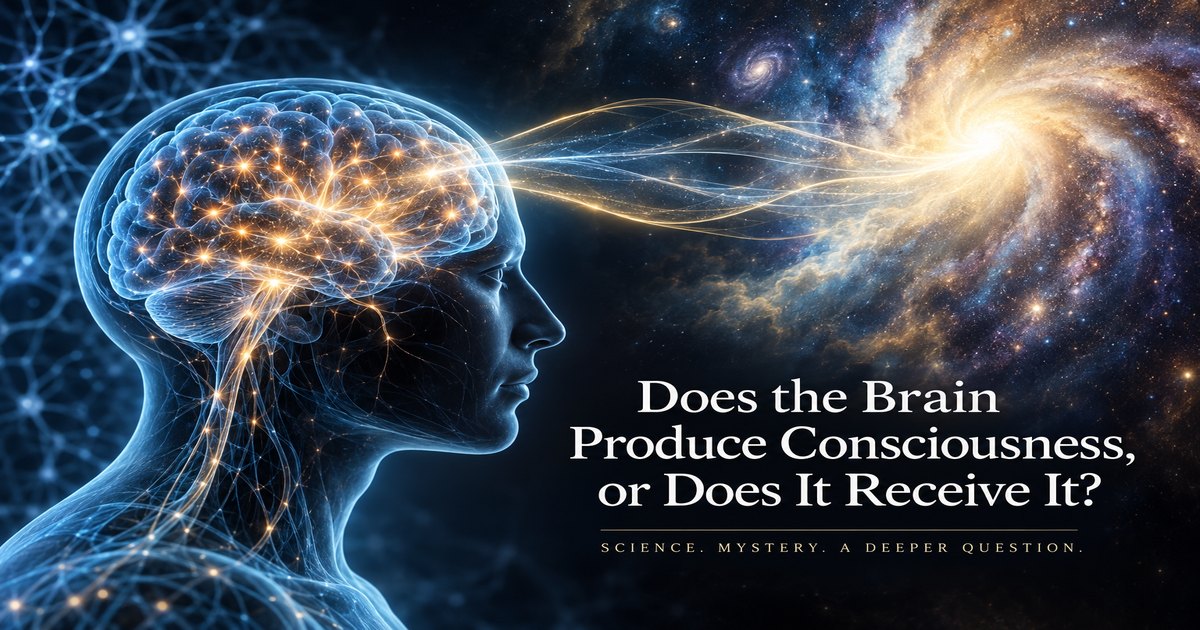
The conventional scientific view is straightforward: the brain produces consciousness.
Neurons fire. Networks communicate. Neurotransmitters move across synapses. Somewhere within that enormous electrochemical system, subjective experience supposedly emerges.
Damage the brain and consciousness changes. Alter brain chemistry and consciousness changes. Suppress brain activity with anesthesia and consciousness can disappear entirely.
The conclusion seems obvious.
The brain creates the mind.
But there is a subtle problem.
Virtually all of this evidence demonstrates that consciousness depends on the brain for its normal expression.
That is not necessarily the same thing as demonstrating that the brain produces consciousness in the first place.
There is another possibility.
Perhaps the brain does not generate consciousness.
Perhaps it receives it.
Or filters it.
Or constrains something that exists independently of the biological machinery through which we experience it.
That idea sounds radical only because we have become accustomed to assuming the alternative.
The uncomfortable truth is that science still does not know what consciousness actually is.
We Know What the Brain Does to Consciousness
There is no serious dispute that the brain profoundly affects conscious experience.
Stimulating particular regions of the brain can produce sensations, memories, movements, emotions, or perceptual distortions.
Damage to particular regions can eliminate the ability to recognize faces, form memories, understand language, perceive part of the visual field, or control behavior.
Psychoactive drugs can radically alter perception simply by changing neurotransmitter activity.
General anesthesia can apparently turn consciousness off and then allow it to return.
Severe brain injury can leave a person conscious but unable to communicate, partially conscious, or apparently unconscious.
Modern neuroscience has become increasingly sophisticated at identifying neural correlates of consciousness—patterns of brain activity associated with conscious states.
Researchers have proposed several competing frameworks, including Global Neuronal Workspace Theory, Integrated Information Theory, higher-order theories, recurrent-processing theories, and predictive-processing approaches.
There is still no consensus about which, if any, provides the correct explanation.
The relationship between brain activity and consciousness is undeniable.
What remains uncertain is the direction of causation.
The Radio Problem
Imagine someone who has never encountered radio technology.
You give him a radio.
Music comes from the speaker.
He opens the device and begins experimenting.
Remove the antenna and the music deteriorates.
Damage the amplifier and the sound becomes distorted.
Cut power to part of the circuitry and the music disappears entirely.
Change the tuning circuit and a different station appears.
After thousands of experiments, he establishes an extraordinarily precise relationship between components inside the radio and the sound coming from the speaker.
He might reasonably conclude:
The radio creates the music.
But he would be wrong.
The radio is essential to the local manifestation of the music, but the underlying signal originates elsewhere.
Every experiment demonstrating a relationship between the circuitry and the music would still be valid.
The interpretation would be wrong.
This is the basic argument behind the receiver or filter model of consciousness.
The brain may be less like a generator and more like an extraordinarily sophisticated biological interface through which consciousness operates.
Damaging the interface would therefore damage the expression of consciousness without necessarily damaging consciousness itself.
The radio analogy does not prove that this is what the brain does.
But it exposes an important logical distinction.
Dependence is not necessarily production.
The Strongest Argument for the Brain-Producing Model
The strongest evidence for the conventional position is not merely that brain activity correlates with consciousness.
It is how extraordinarily specific those correlations can become.
Damage one area and a person loses a particular cognitive ability.
Damage another and personality can change.
Sever communication between the brain’s hemispheres and unusual divisions of perception and behavior can emerge.
Stimulate certain neural circuits and specific experiences can sometimes be produced.
Alter a person’s brain chemistry and the entire character of subjective reality can change.
This is exactly what we would expect if consciousness were generated by biological computation.
There is another argument.
Evolution provides an obvious mechanism for building increasingly complex nervous systems. Primitive organisms respond to their environment. More sophisticated nervous systems integrate larger amounts of sensory information. Eventually brains develop memory, prediction, planning, language, and self-reflection.
From this perspective consciousness may simply be what sufficiently complex information processing feels like from the inside.
There is only one major problem.
Nobody knows why that should happen.
The Hard Problem Never Went Away
Suppose neuroscience eventually maps every neuron in the brain.
We understand every neurotransmitter.
We know exactly how visual information travels from the retina through the brain.
We can mathematically describe the neural state corresponding to seeing the color red.
One question would still remain:
Why does any of that processing produce the subjective experience of redness?
A computer can process a wavelength.
A camera can detect it.
An algorithm can classify it.
None of that obviously requires an internal observer experiencing the color.
This gap between physical processing and subjective experience is sometimes called the hard problem of consciousness.
It is fundamentally different from explaining cognition.
We can imagine explaining how the brain stores memories.
We can explain how it recognizes faces.
We can explain how attention works.
We can explain why an organism withdraws its hand from something hot.
Those are problems of information processing.
But pain is not merely information about tissue damage.
Pain feels like something.
And no known physical law explains why a particular arrangement of matter should suddenly acquire an inner point of view.
That is where the simple statement that “the brain produces consciousness” begins to look less like an established discovery and more like a hypothesis.
A very successful hypothesis, perhaps.
But still a hypothesis.
Neuroscience Has Found Correlates, Not a Consciousness Generator
This distinction appears even in the terminology of consciousness research.
Scientists commonly search for the neural correlates of consciousness.
A correlate is something reliably associated with something else.
Finding the neural activity associated with seeing a face does not, by itself, explain why that activity produces an experience.
Even the major neuroscientific theories disagree about which neural mechanisms are essential.
A major experiment published in Nature in 2025 directly tested predictions from two leading theories—Global Neuronal Workspace Theory and Integrated Information Theory.
The results supported aspects of both while challenging important predictions made by each.
In other words, decades into modern consciousness research, even leading theories still disagree about the mechanisms underlying conscious experience.
That does not mean neuroscience is failing.
It means the problem is genuinely difficult.
What Would a Receiver Model Look Like?
The receiver model does not necessarily require anything supernatural.
Its simplest form proposes that consciousness is somehow fundamental and that brains interact with it.
The brain might function as a:
- receiver,
- filter,
- limiter,
- localizer,
- or interface.
The individual personality we experience could still depend heavily on the physical brain.
Memory retrieval might depend on it.
Language certainly appears to.
Sensory processing does.
Decision-making may.
The receiver hypothesis therefore does not require believing that every aspect of a person’s ordinary mental functioning exists independently of the brain.
Instead, it makes a narrower claim:
The fundamental capacity for subjective awareness may not originate inside neurons.
That possibility resembles other situations where something can exist independently of the device detecting or processing it.
Eyes do not create light.
Ears do not create sound waves.
Televisions do not create the broadcast signals they display.
Antennas do not create electromagnetic radiation.
Whether consciousness belongs in such a category remains unknown.
Brain Damage Does Not Automatically Settle the Question
One common objection to the receiver model is dementia.
If consciousness exists independently of the brain, why does Alzheimer’s disease destroy someone’s memories, reasoning, personality, and ability to communicate?
It is a powerful objection.
But once again, the answer depends upon the architecture of the system.
A damaged television may display a corrupted image even though nothing happened to the broadcast.
A computer with a defective display may contain perfectly intact data that it can no longer present correctly.
If the brain serves as the interface between consciousness and physical behavior, then deterioration of that interface could theoretically produce exactly what we observe.
But there is an important limitation to this argument.
The analogy can explain almost anything after the fact.
That makes it dangerous.
If every piece of evidence linking mental impairment to brain impairment is dismissed as “damage to the receiver,” the receiver hypothesis becomes impossible to falsify.
A scientific theory must eventually make predictions that distinguish it from competing explanations.
Without those predictions, the receiver model remains an interesting philosophical possibility rather than an established scientific theory.
Then There Are the Anomalies
Certain phenomena become particularly interesting under this framework.
One is terminal lucidity.
There are reports of severely cognitively impaired patients unexpectedly regaining clarity shortly before death.
Cases have historically included patients suffering from advanced neurological disease, dementia, tumors, strokes, and other severe disorders.
The phenomenon is poorly understood and difficult to study because it is unpredictable.
The conventional explanation is that unusual changes occurring in the dying brain temporarily restore function through mechanisms we do not yet understand.
That is entirely possible.
But under the receiver model, terminal lucidity raises a different possibility.
Perhaps the deteriorating brain normally prevents a person’s consciousness from being expressed properly, and some change near death briefly alters that constraint.
Again, this is not proof.
It is simply a phenomenon for which the mechanism remains unsettled.
Near-Death Experiences Are Even More Controversial
Near-death experiences present a similar problem.
Some survivors of cardiac arrest report remarkably vivid experiences involving awareness, structured thought, memories, unusual perceptions, encounters with deceased people, or the sensation of observing events from outside their bodies.
One interpretation is straightforward.
The brain is undergoing extreme physiological stress.
Oxygen levels change.
Neurotransmitter systems behave abnormally.
Electrical activity changes.
Memory formation may become distorted.
The resulting experience is extraordinary precisely because the brain is in an extraordinary condition.
There is evidence that organized neural activity can occur in the dying brain, providing plausible mechanisms through which at least some near-death experiences might arise.
But the debate is not completely closed.
Some researchers argue that the timing and reported clarity of certain experiences during cardiac arrest are difficult to reconcile with conventional models.
That interpretation remains controversial.
Near-death experiences are not evidence strong enough to establish consciousness outside the brain.
But neither is simply labeling them hallucinations an explanation.
The interesting scientific question is whether every feature of the phenomenon can ultimately be accounted for by measurable brain activity.
That is testable in principle.
The Question Science Really Needs to Answer
The decisive experiment would somehow separate brain activity from conscious awareness.
If detailed, verifiable conscious perception could repeatedly occur while researchers could confidently establish that the neural processes normally considered necessary for consciousness were absent, the conventional production model would face a serious problem.
Conversely, if neuroscience eventually demonstrated a complete causal chain from physical processes to conscious experience—allowing specific subjective states to be predictably generated, manipulated, and explained from neural mechanisms alone—the receiver hypothesis would become increasingly unnecessary.
At present, we are somewhere in between.
We can manipulate consciousness remarkably well.
We can correlate experience with brain activity.
We can identify networks necessary for normal conscious processing.
We can suppress consciousness.
We can restore it.
What we cannot yet do is explain why physical processing produces subjective experience at all.
That is an enormous missing piece.
There May Be a Third Possibility
The debate is often framed as having only two choices:
The brain creates consciousness.
or
The brain receives consciousness from somewhere else.
Reality may be stranger than either.
Consciousness could be a fundamental property of nature.
It could emerge only from certain kinds of information integration.
It could exist in primitive forms throughout physical systems and become organized by brains.
Space, matter, information, and consciousness might ultimately be aspects of a deeper underlying structure that our current physics does not describe.
Or consciousness may indeed be entirely generated by biological brains and we simply have not discovered how.
Every one of these possibilities creates difficult philosophical and scientific problems.
None currently has a decisive experimental victory.
The Assumption Hiding in Plain Sight
Most people rarely ask whether the brain produces consciousness because the idea is embedded so deeply in modern thinking that it feels like an observation rather than an assumption.
But consider what we actually observe.
We observe brains.
We observe electrical activity.
We observe behavior.
And each of us directly experiences our own consciousness.
What nobody has ever observed is consciousness being manufactured by a neuron.
We infer that production because changes in the brain reliably change experience.
It may turn out to be exactly the correct inference.
But inference should not be confused with demonstration.
The brain is unquestionably involved in consciousness.
It may even be entirely responsible for consciousness.
Yet those statements are not identical.
Until we understand how objective physical activity becomes subjective experience—or discover that our premise was wrong—the fundamental relationship between mind and brain remains unresolved.
The brain may be a generator.
It may be a receiver.
It may be something far stranger than either.
And the fact that we still cannot confidently distinguish those possibilities may tell us something important.
The greatest mystery of consciousness is not what the brain does when we are conscious.
It is why there is anyone inside experiencing it at all.