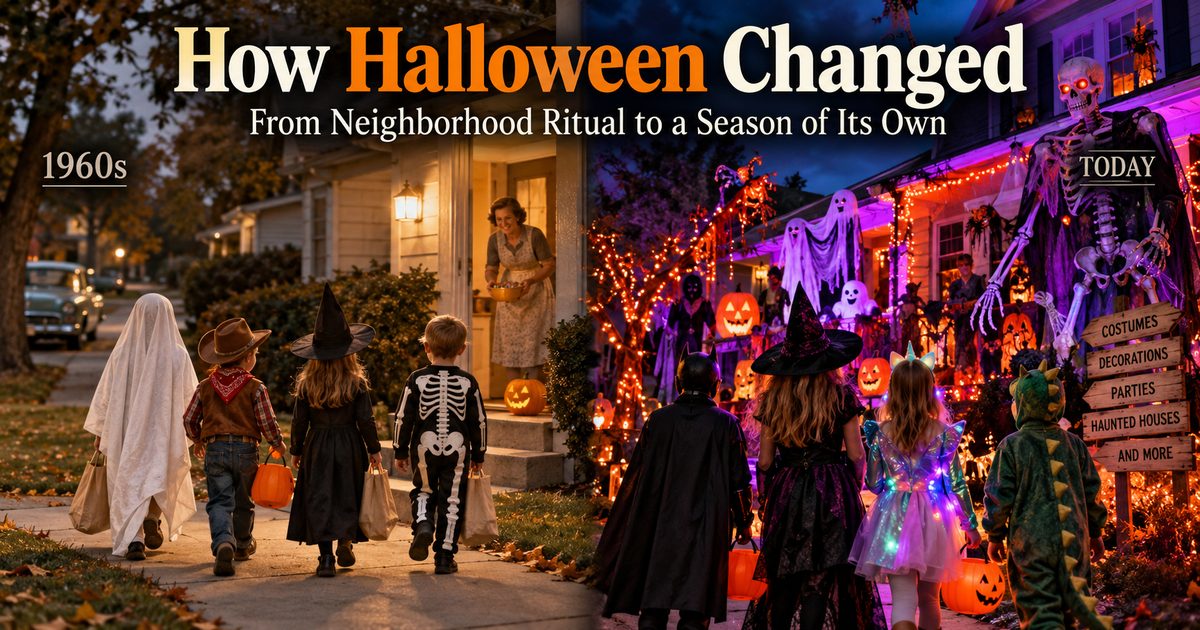
Halloween in 1960 would be instantly recognizable to someone living today. There were costumes, jack-o’-lanterns, haunted houses, candy and children wandering through neighborhoods yelling “trick or treat.”
But the experience surrounding those traditions was very different.
Halloween was primarily a children’s holiday. Costumes were simpler. Decorations were modest. Trick-or-treating was centered on the immediate neighborhood. Homemade treats were still acceptable. Parents were generally less involved. And October 31 was the event—not merely the finale of a Halloween season that had begun sometime in September.
Over the next sixty years, nearly every part of that experience changed.
Halloween became safer in some ways, more fearful in others, enormously more commercial, increasingly elaborate and much less exclusively about children.
The interesting story isn’t that Halloween survived.
It’s that Halloween became something much larger than it used to be.
The 1960s: Halloween Belonged to the Neighborhood
By the beginning of the 1960s, the basic structure of modern American Halloween had already formed.
The postwar suburban boom had created neighborhoods filled with young families and enormous numbers of children. Trick-or-treating was perfectly suited to that environment. A child could leave the house, walk from door to door and collect candy from dozens of nearby homes.
Adults largely stayed home and distributed treats.
Children owned the streets.
Candy was already becoming an important part of Halloween, but the definition of a “treat” was much broader than it is today. Children might receive cookies, popcorn balls, nuts, apples, coins or commercially packaged candy. Full-sized portions were common compared with today’s miniature Halloween packages.
Candy manufacturers were quickly discovering the commercial opportunity. By 1965, Halloween candy and costume sales were already estimated at roughly $300 million.
Costumes were changing as well.
The homemade ghost created from an old bedsheet was increasingly joined by inexpensive mass-produced costumes depicting television characters, superheroes, monsters and cartoon characters. Popular culture was beginning to replace traditional witches, ghosts and hobos as the primary source of costume ideas.
But the celebration remained fundamentally local.
Your Halloween universe consisted mostly of your street and the streets around it.
That would soon begin to change.
The 1970s: Halloween Becomes More Pop Culture
During the 1970s, Halloween increasingly reflected whatever Americans had recently seen on television or at the movies.
Costumes became more topical.
Star Wars arrived in 1977 and almost immediately supplied Halloween with Darth Vader, Princess Leia, C-3PO and other instantly recognizable characters. Political masks became popular as well, particularly Richard Nixon masks during and after Watergate.
Halloween was becoming a kind of annual snapshot of American culture.
Whatever had captured the public imagination during the previous year could appear at the front door on October 31.
At the same time, something much more important was happening.
Americans were becoming afraid of the candy.
Stories began circulating about razor blades hidden in apples, poisoned candy and strangers intentionally injuring trick-or-treaters.
The image was terrifying precisely because Halloween depended upon an unusual social arrangement:
Parents were sending their children to strangers’ houses and allowing those strangers to give them food.
That required trust.
And that trust began to erode.
The Halloween Sadist
The fear of poisoned Halloween candy became one of the most persistent urban legends in modern American culture.
Stories of strangers randomly poisoning children were repeated in newspapers, television reports and conversations among parents. The threat became accepted as common knowledge even though researchers studying reported incidents found little evidence of the widespread stranger-poisoning phenomenon people feared.
There were real crimes involving Halloween candy, but some of the most infamous cases were very different from the stranger-danger narrative.
In 1974, for example, eight-year-old Timothy O’Bryan died after eating cyanide-laced Halloween candy. The killer was not a mysterious stranger handing out poisoned candy.
It was his father.
Nevertheless, cases such as this reinforced a much broader fear that anything obtained while trick-or-treating might be dangerous.
The 1982 Tylenol poisonings—although unrelated to Halloween—added another powerful image to the public consciousness: a consumer product could be deliberately tampered with and appear perfectly normal.
By the early 1980s, inspecting Halloween candy had become almost a parental ritual of its own.
And the nature of the Halloween treat changed permanently.
Homemade cookies?
Suspicious.
Popcorn balls?
Suspicious.
An unwrapped apple?
Definitely suspicious.
Factory-sealed candy became the trusted standard.
How Packaged Candy Benefited From the Safety Panic
There is no credible evidence that major candy companies invented or deliberately spread stories about poisoned Halloween candy in order to eliminate homemade treats.
That claim would go beyond what the historical record supports.
But the industry clearly benefited from the cultural shift that followed.
Candy companies had already been marketing packaged candy specifically for Halloween by the 1950s, long before fears about tampered treats reached their peak. Packaged candy was convenient, inexpensive and easy to distribute, but it still competed with apples, cookies, popcorn balls, nuts and other homemade or unpackaged treats.
Then the safety panic changed the meaning of packaging.
A sealed wrapper became more than packaging.
It became evidence of safety.
A familiar corporate logo reassured parents that the candy had come through a controlled manufacturing process and had not been handled in someone’s kitchen.
The homemade treat experienced the opposite transformation.
What had once represented hospitality increasingly represented uncertainty.
That created an enormous structural advantage for commercial candy manufacturers, whether they had anything to do with creating the fear or not.
In fact, there is evidence that the candy industry itself was not enthusiastic about the poisoned-candy panic. Researchers who spent years studying Halloween tampering found virtually no evidence of the widespread stranger poisonings people feared, and the confectionery industry had an incentive to reassure consumers rather than frighten them away from candy altogether.
So the more interesting conclusion is not conspiracy.
It is consequence.
The candy industry did not need to invent the fear to profit from what the fear produced.
Once parents decided that a factory seal was safer than a neighbor’s kitchen, Halloween candy had effectively become a packaged-goods market.
The irony is hard to miss.
At one point in American history, people were more likely to trust something made by a neighbor than something made in a distant factory.
By the end of the twentieth century, Halloween had reversed that relationship.
The anonymous factory was trusted.
The neighbor became the potential threat.
The 1980s: Halloween Gets Scarier
The 1980s transformed the visual language of Halloween.
Traditional monsters such as Dracula, Frankenstein’s monster, witches and ghosts remained, but Hollywood horror was producing an entirely new collection of characters.
Michael Myers had arrived with Halloween in 1978.
Then came Friday the 13th in 1980.
A Nightmare on Elm Street followed in 1984.
Jason Voorhees, Freddy Krueger and Michael Myers became not merely movie villains but cultural icons.
Halloween costumes became bloodier and more graphic, while haunted attractions increasingly borrowed the style of contemporary horror movies.
The haunted house itself was also changing.
Community groups had operated Halloween haunted houses for decades, often as fundraisers. But during the 1980s and 1990s, professionally operated attractions became increasingly sophisticated.
Instead of walking through a darkened community-center basement while volunteers jumped from behind sheets, visitors could encounter elaborate sets, professional lighting, animatronics, makeup and increasingly sophisticated special effects.
Halloween was becoming an entertainment industry.
The retail side was evolving at the same time.
Spirit Halloween began in 1983 and eventually turned the temporary Halloween store into a familiar part of the American retail landscape—the mysterious seasonal store that suddenly materializes inside an empty shopping center every autumn.
Halloween was beginning to escape October 31.
It was becoming a season.
The 1990s: Adults Take Halloween Back
Perhaps the biggest cultural change of the 1990s was the realization that Halloween did not have to end when you became too old to trick-or-treat.
Adults increasingly dressed in costume.
Bars held Halloween events.
Offices held costume contests.
Private Halloween parties became common.
Costume companies responded with increasingly elaborate products designed specifically for adults. Commercial versions of deliberately provocative or “sexy” costumes also became an established part of the retail market during the decade.
This represented an important change.
For much of the postwar era, Halloween had operated almost like childhood infrastructure. Adults facilitated the event, but children were the participants.
Now adults were participants too.
And adults had money.
That dramatically expanded what could be sold.
More expensive costumes made sense.
Professional haunted attractions made sense.
Elaborate parties made sense.
More expensive decorations made sense.
Halloween was no longer limited by a child’s allowance or a parent’s willingness to buy a plastic mask.
A second Halloween economy had emerged.
The 2000s: Trick-or-Treating Moves Toward Organized Safety
The traditional version of trick-or-treating depended upon children moving somewhat independently through their neighborhoods.
That became increasingly uncommon.
Parents accompanied younger children. Organized community events became more popular. Shopping centers, churches, schools and other organizations created controlled Halloween environments.
One increasingly familiar alternative was “trunk or treat,” where adults decorated vehicles in a parking lot and children moved from car to car collecting candy.
The basic transaction was identical to trick-or-treating.
The social structure was completely different.
Traditional Halloween said:
Go through the neighborhood.
The newer model said:
Come to this designated place where we can control the environment.
The change reflected something much larger than Halloween.
Children’s independence had generally declined compared with previous generations. Wandering several streets away from home without adults—the ordinary experience of many children in the 1960s and 1970s—had become far less acceptable.
Halloween followed the broader culture.
The 2010s: The Yard Becomes the Costume
Another transformation was taking place in front of the house.
Halloween decorations had once been relatively simple.
A carved pumpkin.
A paper skeleton.
Perhaps a fake spiderweb or cardboard witch in the window.
By the 2010s, residential Halloween displays could involve projection systems, synchronized lighting, fog machines, inflatable characters, animated creatures, enormous skeletons and entire front yards converted into miniature haunted attractions.
The house itself became part of the performance.
Social media accelerated the trend.
A spectacular Halloween display was no longer visible only to the people who happened to drive past it. A clever decoration could be photographed, shared and viewed millions of times.
Manufacturers responded with bigger and more elaborate products.
Halloween decorations gradually began occupying a retail position once associated primarily with Christmas decorations.
That shift is now visible in the numbers.
In 2019, American consumers were expected to spend about $2.6 billion on Halloween decorations.
By 2024, that had climbed to approximately $3.8 billion.
By 2025, projected decoration spending had reached $4.2 billion—more than projected spending on Halloween candy.
That would have been almost unimaginable during the neighborhood Halloween of 1960.
Halloween Becomes a Season
The Halloween aisle once appeared in stores shortly before October.
Now Halloween merchandise routinely arrives while summer is still underway.
Seasonal Halloween stores begin opening near the end of summer. Dedicated enthusiasts begin buying decorations before October. Horror conventions, haunted attractions, streaming movie collections, pumpkin festivals and elaborate home decorating extend the experience across weeks rather than a single evening.
Nearly half of Halloween shoppers now begin shopping in September or earlier.
Halloween has undergone the same expansion that occurred with Christmas.
The holiday became a season.
October 31 is now the conclusion.
It is no longer the entire event.
2020: The Halloween That Couldn’t Trick-or-Treat
The COVID-19 pandemic temporarily challenged one of Halloween’s defining characteristics: knocking on strangers’ doors.
Traditional trick-or-treating became difficult or discouraged in many communities.
But Halloween proved unusually adaptable.
People created socially distanced candy delivery systems.
Families built candy chutes from PVC pipe.
Neighborhoods developed drive-through events.
People increased home decorating.
And because decorating did not require gathering indoors with other people, it became one of the easiest Halloween traditions to preserve.
That pandemic-era enthusiasm for decorations did not disappear when normal social activity returned.
Halloween absorbed the disruption and continued growing.
Halloween Today: Children Are Only Part of the Market
The modern Halloween economy barely resembles the children’s holiday of the 1960s.
In 2025, the National Retail Federation projected Americans would spend a record $13.1 billion celebrating Halloween.
Approximately:
- $4.3 billion would be spent on costumes.
- $4.2 billion would be spent on decorations.
- $3.9 billion would be spent on candy.
- $700 million would be spent on greeting cards.
Nearly three-quarters of surveyed consumers planned to celebrate Halloween in some form.
About half planned to wear a costume.
Nearly a quarter planned to dress up a pet.
Think about what those numbers reveal.
Candy is no longer even the largest Halloween spending category.
Costumes and decorations are larger.
That means the economic center of Halloween is no longer simply millions of children carrying plastic pumpkins from house to house.
The adults are now as economically important to Halloween as the children.
Perhaps more so.
What Halloween Gained
It is easy to romanticize the Halloween of the past, but modern Halloween has gained quite a bit.
Costumes are vastly better.
Decorations are more imaginative.
Professional haunted attractions can rival theatrical productions.
People who love horror can effectively celebrate for two months.
Adults no longer have to abandon Halloween simply because they turned eighteen.
Communities create elaborate events that would have been impossible generations ago.
Halloween has also become unusually flexible.
It can be frightening or funny.
Adult or childlike.
Commercial or homemade.
A neighborhood event or a private party.
A horror celebration or simply an excuse to eat candy and carve pumpkins.
Few holidays allow participants that much freedom.
What Halloween Lost
Something disappeared along the way as well.
The Halloween of 1960 depended on a surprising amount of social trust.
Children walked through the neighborhood.
Neighbors opened their doors.
People gave children food they had made themselves.
Parents did not necessarily inspect every item before allowing it to be eaten.
Children might know the adults whose houses they visited—or they might not.
The system worked largely because everyone assumed that the people living around them were part of the same community.
Modern Halloween is much more controlled.
Children are supervised.
Treats are factory sealed.
Candy is inspected.
Events are organized.
Routes are planned.
Parents remain close.
That may be safer.
But it is unquestionably different.
The evolution of Halloween therefore tells us something about the evolution of American society itself.
We became wealthier.
We became more commercial.
We became more technologically sophisticated.
We became better at producing entertainment.
And somewhere along the way, we became considerably less comfortable trusting the people around us.
From One Night to an Entire Season
A child waking up on October 31, 1965 understood Halloween perfectly well.
Put on a costume.
Grab a bag.
Wait for darkness.
Go outside.
The entire neighborhood would be doing the same thing.
Halloween today contains all of those elements, but they are surrounded by something much larger.
There are six-foot animatronic monsters in September.
Pop-up Halloween stores occupy abandoned department stores.
Adults spend hundreds or thousands of dollars decorating their houses.
Professional haunted attractions operate for weeks.
Pets have costumes.
Social media spreads decorating trends nationally overnight.
Horror movies and television series generate next year’s costumes before this year’s pumpkins have rotted.
And children still walk up to front doors and say the same three words children were saying sixty years ago:
Trick or treat.
That may be the most remarkable part of Halloween’s evolution.
Nearly everything surrounding the tradition has changed.
But at its center is still an oddly simple agreement between neighbors:
For one night, turn on the porch light, open the door and give the kid some candy.