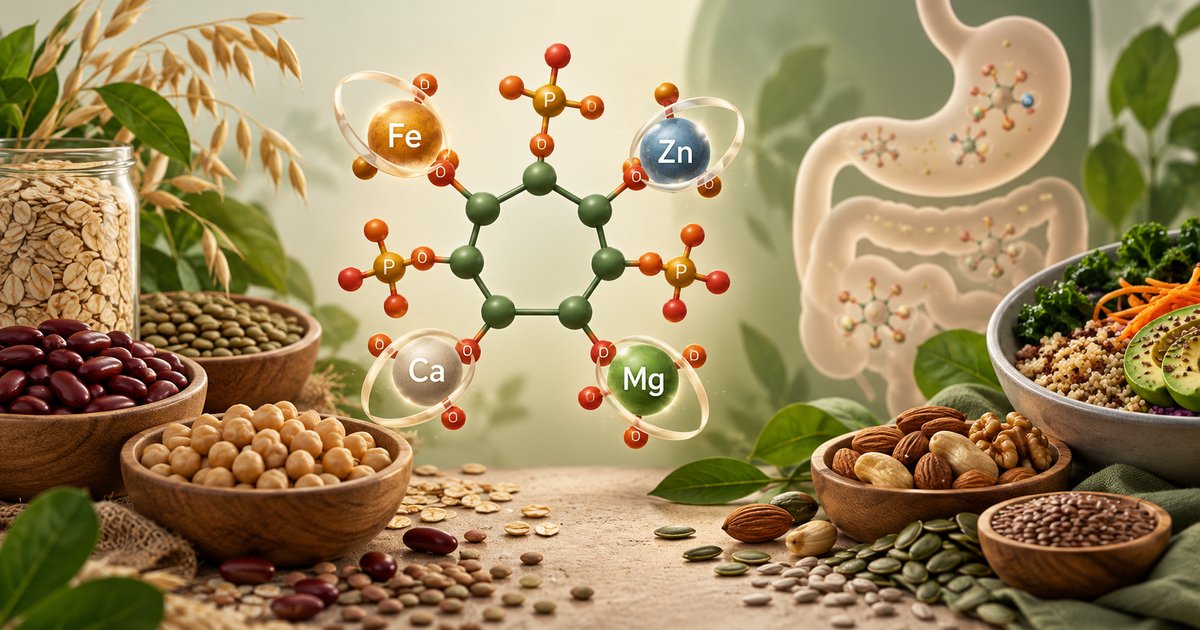
 The amount of a mineral contained in a food is not necessarily the amount of that mineral the human body can absorb. Phytate, a natural phosphorus-storage compound concentrated in many grains, legumes, nuts, and seeds, can bind dietary minerals inside the gastrointestinal tract and reduce their bioavailability. The effect is particularly well established for iron and zinc and is one reason that comparing foods solely by the mineral values printed in a nutrient database can be misleading.
A plant food can therefore be chemically rich in a mineral while delivering substantially less of that mineral to human tissues.
This distinction becomes especially important in vegan diets, because many of the foods used as primary sources of iron, zinc, calcium, and magnesium are also among the foods highest in phytate.
The Baseline Assumption: Nutrient Content Equals Nutrient Availability
Nutrition discussions commonly compare foods according to their measured nutrient content.
A serving of a particular seed might contain several milligrams of iron. A legume might contain substantial magnesium. A whole grain might contain more zinc than its refined counterpart.
Those numbers are chemically correct.
The problem is the assumption that follows:
If a food contains a certain amount of a mineral, the body receives that amount of the mineral.
Human digestion does not work that way.
Before a mineral can contribute to human physiology, several things must occur:
- The mineral must be released from the food matrix.
- It must remain soluble within the gastrointestinal environment.
- It must remain chemically available for interaction with the intestinal surface.
- It must reach an appropriate intestinal transporter.
- It must cross the intestinal epithelium.
- It must enter circulation and become available to tissues.
A substance that interferes with those steps can reduce the nutritional value of a mineral without changing the amount of that mineral measured in the original food.
Phytate does exactly that.
What Is Phytate?
Phytic acid, also called myo-inositol hexakisphosphate or IP6, is a phosphorus-rich molecule synthesized by plants.
When phytic acid carries associated mineral ions, its salt form is generally referred to as phytate.
Plants primarily use phytate as a storage system for phosphorus, particularly in seeds. When a seed begins to germinate, phytase enzymes can break phytate apart and release phosphorus and minerals needed by the developing plant.
Consequently, phytate tends to be concentrated in foods derived from seeds, including:
- Whole grains
- Wheat bran
- Corn
- Oats
- Rice bran
- Soybeans
- Beans
- Lentils
- Peas
- Nuts
- Peanuts
- Seeds
Refining grains often reduces their phytate content because phytate is disproportionately concentrated in the bran and germ.
This creates an interesting nutritional tradeoff. Whole grains can contain more total minerals than refined grains while simultaneously containing more of a compound capable of reducing the absorption of those minerals.
First-Principles Analysis: Why Phytate Binds Minerals
The mineral-binding behavior of phytate follows straightforward chemistry.
Phytic acid contains six phosphate groups.
Under physiological conditions, these groups carry multiple negative charges.
Many nutritionally important minerals exist in the digestive tract as positively charged ions, including:
- Iron: Fe²⁺ and Fe³⁺
- Zinc: Zn²⁺
- Calcium: Ca²⁺
- Magnesium: Mg²⁺
- Manganese: Mn²⁺
Opposite electrical charges attract.
Phytate therefore acts as a chelating agent, associating with positively charged mineral ions.
The resulting mineral-phytate complexes can become poorly soluble or unavailable for interaction with intestinal transport mechanisms.
The process can be reduced to a simple sequence:
Mineral in food → mineral released during digestion → mineral encounters phytate → mineral-phytate complex forms → less free mineral reaches the intestinal absorption system
The mineral has not vanished.
It is still physically present inside the digestive tract.
But nutritional value depends upon absorption, not merely presence.
If the complex cannot be efficiently absorbed, much of it ultimately passes through the gastrointestinal tract rather than entering circulation.
That distinction is fundamental:
A mineral can be present in food without being biologically available to the person eating it.
Iron: One of the Clearest Examples
The inhibitory effect of phytate on iron absorption has been demonstrated directly in controlled human experiments.
As phytate levels rise, non-heme iron absorption generally falls.
The relationship is dose dependent.
Even relatively small quantities of phytate can reduce iron absorption, while larger amounts can produce a substantially stronger effect.
Vitamin C can partially counteract this inhibition by improving the solubility and availability of non-heme iron.
This illustrates why mineral bioavailability cannot be determined from a single ingredient in isolation. The entire meal matters.
Nevertheless, the underlying phytate effect remains clear.
Soy Provides Another Example
When naturally occurring phytate in soy protein is substantially reduced, iron absorption improves.
Removing phytate does not necessarily make iron absorption perfect because other components of the food matrix can continue to inhibit absorption.
That reinforces two points:
- Phytate can be a major inhibitor of mineral absorption.
- Phytate is not the only factor determining mineral bioavailability.
The correct conclusion is therefore not that phytate makes every mineral molecule completely unavailable.
The conclusion is that phytate can substantially reduce the fraction that is available for absorption.
Zinc Is Also Strongly Affected
Zinc absorption is particularly sensitive to dietary phytate.
The relationship between phytate and zinc is sufficiently consistent that the phytate-to-zinc molar ratio is often used when estimating zinc bioavailability from diets.
As dietary phytate increases relative to zinc, the fraction of zinc absorbed generally decreases.
This becomes especially important in diets that rely heavily on:
- Unrefined grains
- Legumes
- Seeds
- Nuts
These foods may contain considerable amounts of zinc on paper while simultaneously providing substantial phytate.
The result is a recurring problem in nutrition analysis:
Total zinc intake can overstate physiologically available zinc intake.
The human body can make some adaptations to differences in zinc availability, but those homeostatic mechanisms have limits. A chronically high-phytate diet can therefore require greater total zinc intake to produce the same amount of absorbed zinc as a lower-phytate diet.
Calcium and Magnesium
Phytate also interacts chemically with calcium and magnesium.
Both are divalent positively charged ions and can participate in mineral-phytate complexes.
The practical nutritional effect is somewhat more context dependent than the effects seen with iron and zinc because absorption is influenced by:
- The amount of phytate consumed
- The amount of mineral consumed
- The ratio between phytate and the mineral
- Gastrointestinal pH
- Other components of the meal
- Food processing
- Individual mineral status
- The overall dietary pattern
It is therefore too simplistic to claim that eating a phytate-containing food prevents calcium or magnesium absorption altogether.
What can reasonably be stated is that phytate is capable of reducing their bioavailability, particularly when phytate intake is high relative to mineral intake.
The Dose Matters
Phytate should not be thought of as an on/off switch.
Eating a small amount does not suddenly prevent all mineral absorption.
The relationship is better understood as a continuum.
As the phytate burden of a meal increases, the probability that minerals will interact with phytate also increases.
This means that the relevant question is not simply:
Does this food contain phytate?
A more useful question is:
How much phytate is present relative to the amount and form of the mineral being consumed?
This helps explain why the effects of phytate are most nutritionally important in diets heavily dependent upon unrefined cereals, legumes, nuts, and seeds.
When most meals contain substantial phytate and relatively little highly bioavailable mineral, the inhibitory effect is repeated meal after meal.
Mineral Content Is Not the Same as Bioavailable Mineral
This exposes a broader weakness in conventional nutrient comparisons.
Consider two hypothetical foods:
| Food | Total Iron | Fraction Absorbed | Absorbed Iron |
|---|---|---|---|
| Food A | 8 mg | 5% | 0.4 mg |
| Food B | 4 mg | 20% | 0.8 mg |
Food A contains twice as much iron.
But Food B delivers twice as much absorbed iron.
A nutrient database ranking would make Food A appear superior.
A physiological analysis would reach the opposite conclusion.
The example is hypothetical, but the principle is real.
This is why discussions of nutrient density that ignore bioavailability can be incomplete.
The biologically relevant quantity is not simply:
nutrient consumed
It is closer to:
nutrient consumed × fraction available for absorption
Why Animal Foods Behave Differently
Phytate is fundamentally associated with plants, particularly plant reproductive structures such as seeds and grains.
Meat, seafood, eggs, and other animal-derived foods do not carry the same phytate burden.
Animal foods also provide minerals in different chemical and food-matrix environments.
Iron illustrates the distinction particularly well.
Plants primarily provide non-heme iron, whose absorption is strongly influenced by other components of a meal, including phytate.
Meat provides both non-heme iron and heme iron. Heme iron is substantially less affected by many of the inhibitors that influence non-heme iron.
Consequently, comparing beans and beef simply by looking at milligrams of iron does not describe their nutritional equivalence.
Chemical quantity is only the first part of the question.
Bioavailability is the second.
Implications for Vegan Diets
The phytate issue is particularly relevant to vegan nutrition because several common vegan staples are simultaneously important mineral sources and major phytate sources.
A typical vegan diet may obtain much of its iron, zinc, magnesium, and calcium from foods such as:
- Beans
- Lentils
- Chickpeas
- Soy
- Whole grains
- Oats
- Nuts
- Seeds
- Nut butters
- Seed butters
These foods can contain substantial quantities of minerals.
But they can also contain substantial phytate.
The practical consequence is that meeting an intake target on paper does not necessarily mean that the same amount of mineral is reaching the bloodstream.
This matters most for iron and zinc.
Iron in Vegan Diets
Vegans obtain iron almost entirely in the non-heme form.
Non-heme iron is more sensitive to the composition of the meal than heme iron.
Its absorption can be reduced by phytate and other plant compounds, while vitamin C can increase it.
This creates a fundamental difference between evaluating iron intake in a mixed diet and in a vegan diet.
A nutrient-tracking application may report that a vegan diet contains a large amount of iron, but the number alone does not reveal how much is likely to be absorbed.
For example, a meal based on lentils, whole grains, seeds, and nuts may appear extremely rich in iron by total content.
But many of those same foods contribute phytate to the meal.
The relevant question is therefore not simply:
How many milligrams of iron are present?
It is:
How much of that iron remains bioavailable after the composition of the entire meal is considered?
This does not mean that adequate iron status is impossible on a vegan diet.
It means that iron intake must be evaluated with bioavailability in mind rather than by milligrams alone.
Zinc in Vegan Diets
The same concern applies to zinc.
Many vegan sources of zinc are phytate-rich foods:
- Legumes
- Whole grains
- Seeds
- Nuts
This creates a built-in nutritional tension.
The food supplying the zinc may simultaneously contain a compound that reduces zinc absorption.
A vegan diet can therefore contain what appears to be an adequate amount of zinc while delivering a lower absorbed amount than a diet containing the same total zinc from lower-phytate foods.
This is one reason zinc requirements and zinc adequacy deserve closer attention in high-phytate dietary patterns.
Calcium Is More Complex
Calcium requires a more nuanced analysis.
Some plant foods contain meaningful amounts of calcium, but calcium bioavailability varies widely among foods.
Phytate can reduce calcium availability, but it is not the only factor.
Oxalate can also strongly inhibit calcium absorption in certain plants.
As a result, a food’s calcium number in a nutrient database does not automatically describe how effective that food is as a calcium source.
For vegan diets, this makes food selection important.
A diet that depends upon poorly absorbed plant calcium sources is not nutritionally equivalent to one that obtains the same number of milligrams from highly bioavailable sources.
Fortified foods can substantially change this calculation because their calcium may be provided in forms with different absorption characteristics and may not carry the same phytate burden as the underlying whole plant food.
The Vegan Nutrient-Tracking Problem
One of the easiest mistakes in vegan nutrition is to evaluate adequacy entirely through a nutrient-tracking application.
A person may enter a day’s food intake and see:
- 120% of the iron target
- 110% of the zinc target
- 100% of the magnesium target
- 100% of the calcium target
That can create the impression that mineral nutrition is fully accounted for.
But a nutrient database generally reports total mineral content, not the actual quantity absorbed by that individual.
It does not necessarily account for:
- Phytate concentration
- Phytate-to-zinc ratio
- Iron enhancers such as vitamin C
- Other inhibitors in the same meal
- Food preparation methods
- Differences in mineral chemical form
- Individual mineral status
- Gastrointestinal physiology
The numerical precision of the application can therefore create a false sense of physiological precision.
The calculation may accurately answer:
How much mineral was present in the food?
while failing to answer the more important question:
How much mineral was absorbed?
A Vegan Diet Can Be Designed Around the Problem
The presence of phytate does not mean a vegan diet cannot provide adequate mineral nutrition.
It means the diet should be designed with bioavailability in mind.
Several approaches can improve the situation.
Pair Iron-Rich Foods With Vitamin C
Vitamin C can substantially improve non-heme iron absorption.
Combining iron-containing foods with foods rich in vitamin C can therefore offset some of the inhibitory effect of phytate.
Examples include combining legumes with:
- Bell peppers
- Citrus
- Tomatoes
- Broccoli
- Other vitamin C-rich foods
The entire meal matters more than the iron content of a single ingredient.
Use Fermentation
Fermentation can activate phytase enzymes and reduce phytate.
Examples include:
- Sourdough bread
- Fermented grain products
- Fermented legumes
- Certain traditional fermented soy foods
A fermented grain product may therefore provide minerals differently from an otherwise similar unfermented product.
Use Sprouting and Germination
Germination activates the seed’s own phytase enzymes.
The biological purpose is to release phosphorus for the growing plant.
The nutritional consequence for humans is that sprouting can reduce phytate and improve mineral availability.
Soaking Can Help, but Results Vary
Soaking grains or legumes can reduce phytate under some conditions.
Its effectiveness varies considerably according to:
- The particular food
- Soaking duration
- Temperature
- Water chemistry
- pH
- Natural phytase activity
- Whether soaking water is discarded
Soaking should not automatically be assumed to eliminate phytate, but it can be part of a broader preparation strategy.
Fortified Foods Can Change the Equation
Fortified plant milks, cereals, and other foods can provide substantial quantities of minerals.
In those cases, the added mineral does not necessarily have the same relationship to phytate as minerals naturally embedded in a seed or grain.
The usefulness of fortified foods therefore cannot be evaluated simply by categorizing them as “plant foods.”
The chemical form and surrounding food matrix still matter.
Vegan Diets Magnify the Importance of Bioavailability
The central nutritional difference is not that phytate behaves differently in a vegan digestive tract.
It does not.
The difference is exposure pattern.
A person eating an omnivorous diet may consume some phytate-rich foods while also obtaining minerals from:
- Meat
- Seafood
- Eggs
- Dairy
- Other lower-phytate foods
A strict vegan diet removes those animal-derived mineral sources.
The remaining diet often becomes more dependent on exactly the categories of foods in which phytate is most concentrated.
That can create a compounding effect:
greater dependence on plant minerals + greater exposure to phytate + absence of heme iron = greater importance of mineral bioavailability
This is not an argument that every vegan will become mineral deficient.
It is an argument that evaluating a vegan diet by total mineral content alone is particularly incomplete.
Traditional Food Preparation Can Reduce Phytate
Humans have developed food-processing techniques capable of reducing phytate, often long before the underlying chemistry was understood.
These include:
- Soaking
- Germination
- Sprouting
- Fermentation
- Sourdough fermentation
- Malting
- Certain forms of milling and processing
Many of these techniques work partly by activating naturally occurring phytase enzymes.
Phytase hydrolyzes phytate by progressively removing phosphate groups.
As phytate is broken into lower inositol phosphates, its ability to bind minerals decreases.
The result can be improved mineral availability.
Fermentation and germination can be particularly effective under appropriate conditions.
Soaking can also reduce phytate, although its effectiveness varies substantially by food, soaking conditions, temperature, pH, phytase activity, and what is done with the soaking water.
Simply cooking a phytate-rich food should therefore not automatically be assumed to eliminate the problem.
A Useful Evolutionary Observation
The phytate molecule exists for the benefit of the plant.
A seed needs phosphorus and minerals to support germination.
Phytate provides a storage mechanism that holds those nutrients until the developing plant requires them.
Once germination begins, the seed activates phytase enzymes capable of dismantling the phytate molecule and releasing its stored phosphorus.
Humans, by contrast, possess limited endogenous capacity to digest intact phytate in the upper gastrointestinal tract.
The molecule that efficiently stores minerals for a seed can therefore reduce mineral availability to the animal consuming that seed.
This does not require phytate to be a “toxin.”
It simply reflects competing biological functions.
What benefits the reproductive strategy of a plant does not necessarily maximize nutrient absorption in a human digestive system.
Does This Mean Phytate-Containing Foods Are Unhealthy?
No.
That conclusion would go beyond the evidence.
Phytate-containing foods can provide:
- Protein
- Fiber
- Vitamins
- Minerals
- Fermentable carbohydrates
- Other bioactive compounds
Phytate itself has also been investigated for possible antioxidant and other biological effects.
The existence of potential benefits, however, does not invalidate its mineral-binding chemistry.
Both can be true.
A compound can exert one potentially useful physiological effect while simultaneously reducing the absorption of particular nutrients.
The relevant question is therefore not whether phytate should be classified as universally “good” or “bad.”
The relevant question is:
What happens to mineral availability when phytate is present in a particular meal and dietary context?
On that question, the answer is considerably clearer.
Phytate can reduce mineral bioavailability.
Vitamin C Demonstrates Why Meal Composition Matters
One of the best examples of nutritional interaction involves vitamin C and non-heme iron.
Ascorbic acid can substantially improve non-heme iron absorption and can counteract some of the inhibitory effect of phytate.
This creates an important distinction between mechanism and outcome.
The mechanism is straightforward:
Phytate inhibits iron availability.
But the final amount of iron absorbed from a meal depends upon competing influences.
A meal might simultaneously contain:
- Phytate that inhibits absorption
- Vitamin C that promotes absorption
- Polyphenols that inhibit absorption
- Protein or amino acids that modify mineral availability
- Different forms of iron with different absorption characteristics
Nutrition therefore cannot always be reduced to isolated compounds.
But the complexity of the food matrix does not make the phytate mechanism disappear.
It simply changes the magnitude of its effect.
Short-Term Absorption and Long-Term Nutritional Status Are Different Questions
Another important distinction is the difference between measuring mineral absorption from a single meal and measuring nutritional status over months or years.
A reduction in mineral absorption from a particular meal does not automatically mean every person consuming phytate will develop a mineral deficiency.
Long-term status also depends upon:
- Total mineral intake
- Frequency of phytate exposure
- Food preparation methods
- Mineral supplementation or fortification
- Other absorption enhancers and inhibitors
- The body’s regulatory mechanisms
- Age
- Physiological requirements
- Existing mineral stores
That distinction matters.
Phytate can reduce mineral absorption without guaranteeing deficiency.
The biological effect is real, but its long-term consequence depends on the broader diet.
The More Plant-Dependent the Diet, the More Relevant Phytate Becomes
For a mixed diet containing animal foods, sufficient total minerals, vitamin C, and a variety of foods, phytate may have relatively little practical consequence for a healthy person with adequate mineral status.
The calculation changes when the diet becomes heavily dependent upon phytate-rich foods.
Consider a diet in which most calories and minerals repeatedly come from:
- Whole grains
- Beans
- Lentils
- Nuts
- Seeds
Now the same mineral-binding mechanism occurs at breakfast, lunch, dinner, and snacks.
At that point, mineral bioavailability becomes much more important when evaluating whether calculated mineral intake reflects actual nutritional adequacy.
This is especially relevant to vegan diets because those foods are often not peripheral components of the diet.
They are the foundation of it.
The Central Error: Measuring What Goes Into the Mouth Instead of What Enters the Body
Nutrient databases measure the chemistry of food.
Human nutrition depends on physiology.
Those are not identical measurements.
If laboratory analysis finds 5 milligrams of zinc in a food, the food contains 5 milligrams of zinc.
But that number does not tell us:
- How much will remain soluble during digestion
- How much will become bound to phytate
- How much will interact with other dietary compounds
- How much will reach intestinal transporters
- How much will cross the intestinal wall
- How much will ultimately become available to tissues
The same distinction applies to iron, calcium, magnesium, and other minerals.
This is why bioavailability must be part of any serious comparison of nutrient density.
For vegan diets, this point is especially important because the distinction between total mineral intake and absorbed mineral intake can recur across nearly every meal.
Conclusion
Phytate demonstrates why nutrition cannot be understood simply by reading nutrient tables.
Plants, particularly grains, legumes, nuts, and seeds, can contain substantial quantities of minerals while simultaneously containing phytate capable of binding those minerals in the gastrointestinal tract.
The mechanism is chemically straightforward:
- Phytate carries multiple negative charges.
- Nutritionally important minerals carry positive charges.
- Phytate binds those mineral ions.
- Poorly soluble or unavailable mineral-phytate complexes can form.
- Less free mineral remains available for intestinal absorption.
The effect is particularly important for iron and zinc, with effects on calcium, magnesium, and other minerals depending more heavily upon dietary context.
For vegans, the issue deserves additional attention because many of the primary dietary sources of minerals are also major sources of phytate. A vegan diet can provide adequate mineral nutrition, but adequacy cannot always be judged reliably from total nutrient intake alone.
The important distinction is therefore not that phytate makes every mineral in a plant food completely unabsorbable.
It is that:
The mineral content of a food and the amount of mineral the human body can actually absorb are two different quantities.
Any nutritional comparison that measures the first while ignoring the second is incomplete.