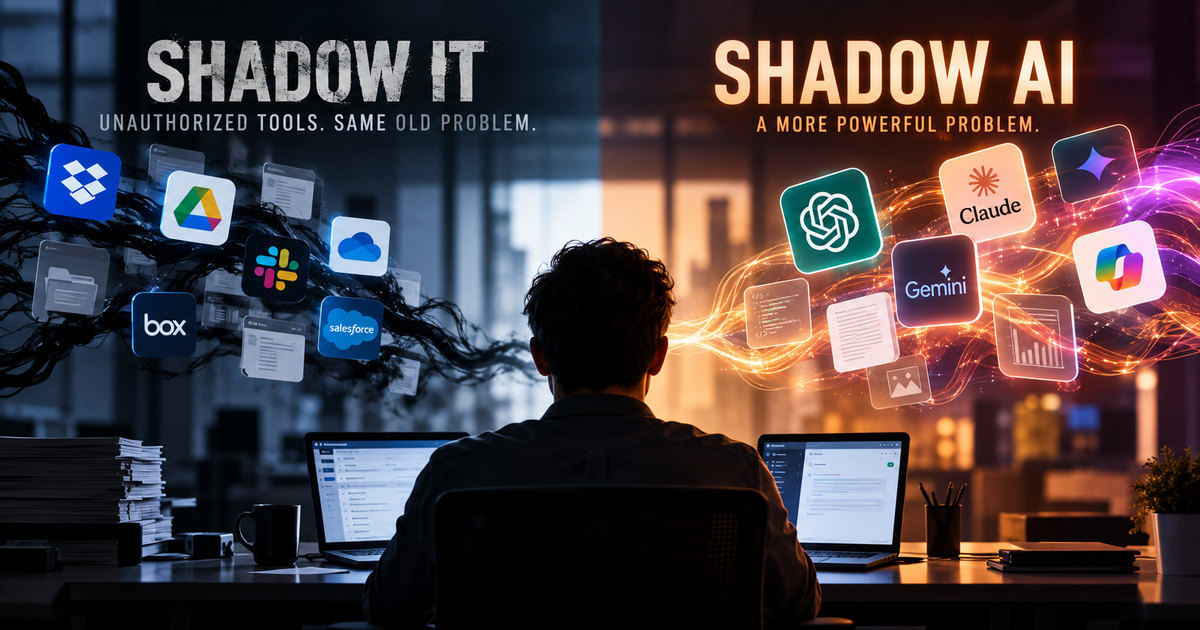
The enterprise spent decades trying to control unauthorized technology. Now employees have access to something far more powerful, far less visible, and infinitely easier to use. And somehow, we think another acceptable use policy is going to solve it.
The Problem You Never Fixed
For decades, IT and cybersecurity departments have fought a losing battle against shadow IT.
Employees purchased unauthorized software, signed up for cloud services, stored corporate data in personal accounts, and built entire business processes outside the visibility of the technology department.
The response was predictable.
IT created policies. Security deployed monitoring tools. Procurement established approval processes. Compliance introduced mandatory training. Executives signed off on governance frameworks.
And employees continued doing whatever made their jobs easier.
The fundamental problem was never a lack of policies. It was that the business moved faster than the organization’s ability to support it.
An employee needed to share a large file with a customer. The approved solution required a ticket, three approvals, and a two-week implementation window.
Dropbox required an email address and about thirty seconds.
Guess which one won.
Now replace Dropbox with ChatGPT, Claude, Gemini, or any of the thousands of AI-powered applications entering the market.
The problem hasn’t changed.
The consequences have.
Shadow IT Was Just the Rehearsal
Traditional shadow IT generally involved employees introducing unauthorized technology into the corporate environment.
An unsanctioned SaaS application might store customer information. A personal cloud account might contain sensitive documents. A departmental database might operate without backups, access controls, or security monitoring.
These were serious problems, but they generally involved identifiable systems, applications, and data repositories.
Shadow AI introduces a different dimension.
An employee doesn’t need to install software, provision infrastructure, or create a persistent data repository to expose sensitive information.
They can simply paste it into a prompt.
A financial analyst uploads an internal earnings forecast and asks an AI assistant to identify inconsistencies.
A developer pastes proprietary source code into a chatbot and requests help debugging it.
A human resources employee submits performance evaluations and asks the model to draft termination recommendations.
A sales representative uploads a customer contract and asks for a competitive analysis.
Each employee believes they are improving productivity.
Each may also be transferring sensitive corporate information into an environment the organization does not understand, govern, or control.
And unlike traditional shadow IT, the exposure may occur in a single interaction lasting less than a minute.
There may be no new application installed, no suspicious executable, no unusual network connection, and no persistent file transfer to an obviously unauthorized destination.
Just an employee doing their job.
With a tool that happens to be capable of processing the company’s most sensitive information.
Your Firewall Isn’t Going to Save You
The traditional security response to unauthorized technology has been to identify it, categorize it, and block it.
That approach becomes increasingly difficult when AI capabilities are embedded into nearly everything.
AI is no longer confined to dedicated chatbot websites.
It exists inside office suites, development environments, browsers, customer relationship management platforms, search engines, collaboration tools, and mobile applications.
An organization might block access to ChatGPT while employees continue using AI capabilities through Microsoft 365, Google Workspace, Salesforce, or an approved SaaS application that quietly introduced an AI assistant during its latest update.
Even the distinction between an approved application and an unauthorized AI service becomes difficult to maintain.
Was the application approved before its AI functionality existed?
Does the vendor send prompts to a third-party model provider?
Are submitted documents retained?
Can customer information cross geographic boundaries?
Are prompts used for model training?
Does the organization even know which AI features its approved vendors have enabled?
A firewall can block a destination.
It cannot determine whether the paragraph an employee just submitted contains a confidential acquisition strategy.
A CASB or DLP platform may help identify and restrict certain activities, but these controls are not universal solutions. They depend on visibility, integration, classification, and the ability to distinguish legitimate business activity from inappropriate disclosure.
And the employee still has a personal phone.
The same employee who once emailed a corporate document to a personal Gmail account can now photograph a screen and ask a personal AI assistant to analyze it.
You can make unauthorized AI usage more difficult.
You cannot realistically eliminate it through network controls alone.
The Productivity Paradox
Here is the uncomfortable reality that many security organizations would rather avoid.
Employees aren’t necessarily adopting unauthorized AI because they are careless, malicious, or indifferent to security.
They are adopting it because it works.
AI can summarize documents, analyze data, troubleshoot technical problems, generate code, prepare presentations, and eliminate hours of repetitive work.
An employee who discovers that a task previously requiring three hours can now be completed in twenty minutes has a powerful incentive to continue using the technology.
Especially when the organization measures that employee on productivity.
Now imagine the employee requests access to an approved AI platform.
The request enters a procurement process. Legal wants to review the contract. Security needs a vendor assessment. Compliance wants a data protection impact assessment. Finance questions the subscription cost.
Six months later, the request is still pending.
Meanwhile, the employee has already completed hundreds of tasks using a personal account.
This is the same organizational failure that created shadow IT.
Security and governance become obstacles to productivity rather than mechanisms that enable it.
The business wants results.
Employees find the shortest path to those results.
And IT discovers the technology after it has already become embedded in daily operations.
The difference is that AI adoption can occur at a scale and speed that traditional enterprise technology never approached.
An employee doesn’t need to understand databases, infrastructure, APIs, or software development.
They just need to know how to ask a question.
You Don’t Even Know What You’re Protecting
Many organizations have spent years implementing data classification programs.
Public. Internal. Confidential. Restricted.
Beautifully documented policies.
Color-coded labels.
Mandatory annual training.
Yet ask those same organizations whether they can reliably identify every location where their sensitive data resides, who has access to it, and which third-party services process it.
The answer is often considerably less impressive than the policy documentation.
Shadow AI exposes the weakness of these programs.
If you cannot identify sensitive information in your existing environment, how do you expect to prevent employees from submitting it to AI services?
If your organization has never established meaningful data ownership, who decides which information can be used with AI?
If your DLP implementation produces so many false positives that employees routinely ignore or work around it, why would adding AI-related detection rules suddenly make it effective?
And if your organization cannot distinguish between genuinely sensitive information and material that merely carries a confidential label, how will it develop practical AI usage restrictions?
The problem isn’t AI.
AI is exposing the security debt that organizations have accumulated for decades.
Weak data governance.
Inconsistent access controls.
Poor asset visibility.
Incomplete vendor inventories.
Ineffective classification.
Security processes that exist primarily to satisfy auditors.
AI didn’t create these problems.
It simply made them much harder to ignore.
The Illusion of an AI Governance Committee
Naturally, the enterprise response is to establish an AI governance committee.
Representatives from IT, security, legal, compliance, human resources, and executive leadership assemble to develop an AI strategy.
They create an acceptable use policy.
They establish a list of approved applications.
They define a review process.
They publish training materials explaining that employees should never submit confidential information to unauthorized AI services.
Then everyone congratulates themselves on having established AI governance.
But governance without operational visibility is largely an administrative exercise.
An approved application list is only useful if the organization knows what applications employees are actually using.
A data handling policy is only useful if employees understand which information they are permitted to submit.
A vendor assessment is only useful if it examines the actual AI functionality, data flows, subprocessors, retention practices, and contractual protections.
And an acceptable use policy is only effective when employees have a practical alternative to the behavior being prohibited.
Otherwise, the organization has simply recreated the shadow IT governance model with different terminology.
The policy says one thing.
The business does another.
Security documents the gap.
And the cycle continues.
Shadow AI Is More Than Data Leakage
Much of the conversation about shadow AI focuses on employees exposing confidential information to external models.
That is a legitimate concern, but it is only one part of the problem.
AI introduces risks that traditional shadow IT governance was never designed to address.
Consider an employee who uses an AI assistant to generate a financial analysis.
The output looks professional. The calculations appear reasonable. The conclusions are presented confidently.
But the model has fabricated a source, misunderstood a financial assumption, or produced an incorrect calculation.
The employee trusts the result and incorporates it into a management presentation.
No sensitive data was leaked.
No unauthorized software was installed.
No malware executed.
Yet the organization has introduced an error into a business decision because an employee treated generated content as verified analysis.
Now consider software development.
A developer uses an unauthorized coding assistant to generate application logic. The resulting code passes basic testing but contains a subtle security vulnerability.
Or a security analyst uses AI to interpret an alert and accepts an incorrect explanation without independently validating the evidence.
Or a legal employee relies on an AI-generated summary that omits a critical contractual obligation.
These are not conventional shadow IT problems.
They are failures of verification, accountability, and human judgment.
The organization must govern not only where information goes, but also how AI-generated information influences decisions.
And that is a substantially more difficult problem than maintaining an application inventory.
The Next Problem: AI That Takes Action
The challenge becomes even more significant as AI evolves from answering questions to performing tasks.
An ordinary chatbot might summarize an email.
An AI agent might read the email, retrieve related documents, access a CRM system, draft a response, and send it.
An employee might connect an AI assistant to a cloud environment and ask it to troubleshoot a production issue.
A developer might authorize an agent to modify source code, execute commands, and submit changes to a repository.
A finance employee might connect an AI workflow to spreadsheets, accounting systems, and payment platforms.
At that point, the concern is no longer limited to what the employee tells the AI.
It includes what the AI can access, modify, transmit, and execute.
An agent operating with excessive permissions can turn a poorly scoped instruction into a significant operational or security incident.
A malicious instruction embedded in a document, webpage, or email may influence the agent’s behavior through prompt injection.
And when an employee independently connects several applications through an AI platform, the organization may have little visibility into the resulting chain of access and automation.
Traditional shadow IT introduced unauthorized applications.
Shadow AI can introduce unauthorized decision-making and execution.
That distinction matters.
An employee using an AI assistant to draft a paragraph is not creating the same risk as an autonomous agent with access to production infrastructure.
Treating both activities as a single category called “AI usage” is an indication that the governance model has not caught up with the technology.
Stop Trying to Ban the Future
The solution is not to abandon security controls or allow unrestricted use of every AI platform.
But repeating the traditional prohibition-first approach is unlikely to produce a different outcome.
Organizations need to acknowledge that AI is becoming a standard productivity tool.
The objective should be to make approved usage easier, safer, and more useful than unauthorized alternatives.
That requires a different operating model.
1. Provide an Approved AI Platform That Employees Actually Want to Use
An approved AI platform that is dramatically less capable than publicly available alternatives will struggle to gain adoption.
Employees need access to tools that genuinely improve their work.
The organization should establish appropriate contractual protections, retention settings, access controls, logging, and data handling requirements.
But the experience must remain useful.
Security that destroys the value of the technology simply encourages employees to find another path.
2. Govern Data, Not Just Applications
The critical question is not merely whether an employee is using an approved AI service.
It is what information the employee is submitting and what the service is permitted to do with it.
Different categories of information require different controls.
Public marketing material does not present the same risk as customer financial records, proprietary source code, credentials, or acquisition plans.
Organizations need practical data classification, clear ownership, and enforceable handling requirements.
Without those foundations, AI governance becomes another collection of documents that cannot be translated into operational controls.
3. Establish Visibility Before Pretending You Have Control
Organizations need to understand which AI services are being used, which sanctioned applications contain embedded AI functionality, and where sensitive information may be flowing.
That visibility may involve SaaS discovery, identity telemetry, endpoint controls, browser security, DLP, vendor assessments, and application-level logging.
No single product provides complete coverage.
And none of these controls should be confused with proof that unauthorized usage has been eliminated.
The objective is to reduce uncertainty and identify meaningful exposure.
4. Separate AI Assistance From AI Autonomy
Generating a draft and executing a production change are fundamentally different activities.
AI systems that can take action require additional safeguards, including narrowly scoped permissions, approval boundaries, audit trails, and restrictions on sensitive operations.
An agent should not inherit unrestricted access simply because the employee who configured it possesses those permissions.
The more consequential the action, the stronger the requirement for independent verification and human authorization.
5. Make Verification Part of the Workflow
Employees need to understand that a convincing AI response is not necessarily a correct response.
Generated code requires review and testing.
Financial calculations require validation.
Legal and regulatory claims require verification against authoritative sources.
Security analysis requires examination of the underlying evidence.
Human accountability does not disappear because an AI system produced the output.
If anything, the ease with which AI generates plausible material makes independent judgment more important.
6. Fix the Approval Process
If approving a new AI capability takes six months while an employee can access an alternative in thirty seconds, the organization has created its own compliance problem.
Security, procurement, legal, and IT need a risk-based process that can move at the speed of business.
Low-risk use cases should not require the same scrutiny as systems processing regulated information or executing privileged operations.
Governance should be proportional to actual exposure, not simply the presence of the letters AI in a product description.
The Real Question Isn’t Whether You Can Stop Shadow AI
You can’t eliminate every instance of unauthorized technology usage.
You couldn’t do it with personal email.
You couldn’t do it with cloud storage.
You couldn’t do it with SaaS applications.
And you are unlikely to do it with AI.
But that doesn’t mean the organization is powerless.
It means the objective needs to change.
The goal is not to produce a policy declaring that shadow AI is prohibited.
The goal is to build an environment where employees have useful approved tools, sensitive data receives appropriate protection, consequential AI outputs are verified, and autonomous systems operate within clearly defined boundaries.
Most importantly, the organization needs to understand why employees are bypassing existing controls.
Because if the answer is that the approved process is too slow, too restrictive, or too disconnected from how people actually work, another security awareness presentation isn’t going to fix it.
The employee who used Dropbox because the corporate file-sharing process was unbearable is the same employee using ChatGPT because the approved AI platform doesn’t exist.
The technology changed.
The incentive didn’t.
Conclusion: AI Isn’t Your Governance Problem. It’s Your Governance Reckoning.
For years, organizations have treated shadow IT as a problem of employee behavior.
Employees were circumventing controls. Employees were introducing risk. Employees weren’t following the approved process.
There was truth in those observations, but they often ignored the underlying organizational failure.
Technology governance had become disconnected from business reality.
AI is forcing that contradiction into the open.
The speed of adoption, accessibility of the tools, and potential consequences of their use make it increasingly difficult to maintain the illusion that policies alone constitute control.
Organizations that never established effective data governance, application visibility, and practical technology approval processes now face a much more complicated challenge.
And the answer cannot simply be another committee, another policy, or another expensive security platform promising complete visibility into an inherently fragmented ecosystem.
You never solved shadow IT because you tried to control how employees worked without adequately addressing why they worked around you.
Shadow AI is the same problem, amplified by technology that can consume information, generate decisions, write software, and increasingly take action on its own.
If you want a different outcome, you need a different approach.
Otherwise, ten years from now, we’ll be discussing the next generation of unauthorized technology while congratulating ourselves on how comprehensive our AI acceptable use policy was.
And employees will still be getting their work done somewhere else.