The most disturbing idea in Soylent Green isn’t that Soylent Green is people.
That is the twist everyone remembers.
The more interesting idea comes much earlier:
Food has ceased to be food.
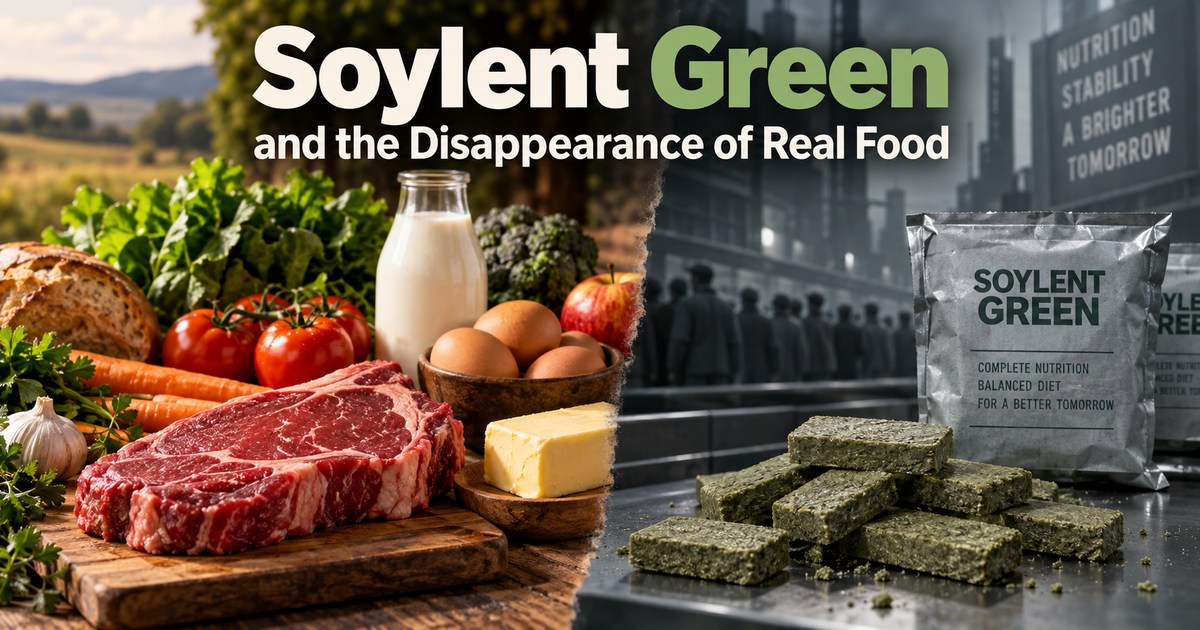
In the world imagined by the 1973 film, most people don’t buy beef, eggs, vegetables, or fruit. They survive largely on standardized nutritional products manufactured by the Soylent Corporation: Soylent Red, Soylent Yellow, and Soylent Green.
Real food still exists, but it has become a luxury.
A piece of beef is treated almost like a precious artifact. Fresh vegetables inspire wonder. An apple isn’t something casually tossed into a shopping cart. It represents a world that has largely disappeared.
The movie imagined this happening because of catastrophic scarcity.
Our world has taken a very different path.
We haven’t run out of food. In much of the developed world, we have achieved something approaching the opposite: an extraordinary abundance of inexpensive calories.
Yet we’ve arrived at a question that would fit remarkably well in the world of Soylent Green:
How much of what we eat still needs to resemble the food from which it came?
When Food Became a Manufactured Product
For most of human history, food was recognizable.
Meat came from an animal.
Eggs came from chickens.
Milk came from mammals.
Vegetables came from plants.
Bread required grain.
Humans have always processed food. We grind wheat, ferment milk, cure meat, brew beer, make cheese, and preserve vegetables. Processing itself isn’t new, and many forms of processing have made food safer and more nutritious.
But there is an important conceptual difference between processing food and engineering a food product.
Modern food manufacturing can begin with refined proteins, starches, oils, sugars, flavor compounds, emulsifiers, stabilizers, colors, preservatives, and other ingredients and assemble them into something designed to deliver a particular experience.
Crunch.
Creaminess.
Sweetness.
Saltiness.
Aroma.
Mouthfeel.
Shelf life.
Convenience.
The final product may bear surprisingly little resemblance to any individual ingredient from which it was constructed.
That doesn’t automatically make the product unhealthy. Food technology has contributed enormously to food safety, preservation, affordability, transportation, and availability.
But it represents a profound change in our relationship with food.
We increasingly don’t just process food.
We design it.
Engineering the Eating Experience
Once food becomes a manufactured product, another possibility appears.
The manufacturer can optimize it.
Food companies use sophisticated sensory testing. Recipes can be adjusted repeatedly to determine which combinations of sweetness, saltiness, fat, texture, aroma, and mouthfeel consumers prefer.
The economic incentive is obvious.
Make something people enjoy enough that they buy it again.
But there is an important difference between designing food to taste good and designing a product that encourages continued consumption.
If Product A leaves consumers satisfied after a small amount while Product B causes them to repeatedly reach into the bag, which product has the greater commercial potential?
That leads directly into the controversial subject of food addiction.
Researchers continue to debate whether highly processed foods should literally be considered addictive in the same sense as nicotine, alcohol, or drugs. The biological mechanisms aren’t identical, and the word addiction shouldn’t be used casually.
But we don’t have to resolve that debate to recognize something important.
Food can be engineered to maximize palatability and encourage continued consumption.
Humans evolved powerful reward systems around calories because calories were historically valuable and often difficult to obtain.
We did not evolve surrounded by supermarkets and convenience stores containing thousands of products capable of delivering highly concentrated combinations of refined carbohydrates, fats, salt, flavor, and texture on demand.
The food environment changed far faster than human biology did.
And once manufacturers discovered how strongly consumers responded to certain combinations, ordinary market competition provided plenty of incentive to continue optimizing them.
No conspiracy is required.
Just economics.
From the Farm to the Factory
Consider how the relationship between a person and food has changed.
A traditional food chain might have looked roughly like this:
Farm → Market → Kitchen → Person
Modern industrial food can involve something considerably more complicated:
Farm → Commodity Processor → Ingredient Manufacturer → Food Manufacturer → Distributor → Retailer → Person
Corn doesn’t necessarily remain corn.
It can become starch, syrup, oil, protein ingredients, maltodextrin, and numerous other substances that eventually appear inside products that don’t look anything like an ear of corn.
Soybeans can similarly disappear into oils, proteins, emulsifiers, and other components.
Wheat can become refined starches, isolated proteins, sweeteners, and texturizing ingredients.
The agricultural origin gradually becomes invisible.
By the time the consumer opens the package, the question isn’t necessarily:
What food is this?
It may instead be:
What product is this?
That distinction is central to Soylent Green.
Nobody asks what plant Soylent Green comes from.
Nobody asks what farm produced it.
Nobody asks how it was made.
Soylent Green isn’t an ingredient.
It’s a brand.
When the Factory Replaces the Animal
We’re now approaching another transformation that would have sounded like science fiction when Soylent Green was released.
For almost all of human history, producing meat required an animal.
Today, considerable research and investment are aimed at partially separating those two things.
Plant-based meat substitutes attempt to reproduce the taste, texture, appearance, and cooking characteristics of meat using plant-derived ingredients.
Precision fermentation can use microorganisms to manufacture particular proteins and other compounds traditionally obtained from animals.
Cultivated meat goes further.
Animal cells are grown under controlled conditions to produce edible tissue without raising and slaughtering an entire animal.
These technologies are fundamentally different from one another. Cultivated meat, in particular, isn’t simply another plant-based meat substitute. It begins with animal cells.
Supporters see potentially enormous advantages: fewer animals raised for slaughter, reduced agricultural land requirements, more controlled production, greater food security, and potentially lower environmental impacts if the technology can eventually operate efficiently at scale.
Critics raise different questions: energy requirements, cost, industrial concentration, scalability, nutritional equivalence, regulation, processing, and whether replacing farms with highly technical manufacturing systems simply creates different dependencies.
Those questions will ultimately have to be answered with evidence as the technologies mature.
But underneath the arguments is a much larger historical development.
Humanity is beginning to ask whether food traditionally produced by animals needs the animal at all.
Whatever one thinks of that development, it represents a remarkable break with the past.
Soylent Green Imagined Scarcity
This is where reality diverges sharply from the movie.
Soylent Green imagined industrial food becoming necessary because humanity could no longer produce enough conventional food.
There simply wasn’t enough to go around.
Modern industrial food largely emerged under very different circumstances.
We became extraordinarily efficient at producing calories.
Agriculture industrialized.
Crop yields increased.
Transportation became cheap.
Refrigeration expanded.
Food preservation improved.
Global supply chains developed.
Factories learned to turn inexpensive agricultural commodities into enormous numbers of shelf-stable products.
The result in wealthy societies wasn’t calorie scarcity.
It was calorie abundance.
That distinction matters.
We’re not living in Soylent Green.
But we have nevertheless arrived at an interesting philosophical intersection with the movie.
The fictional world asks:
How do we manufacture enough calories when traditional food becomes impossible to produce?
Our world increasingly asks:
How efficiently can we manufacture desirable calories from agricultural inputs?
Those aren’t the same problem.
But both can move food progressively farther from its original biological source.
The Steak Matters More Than the Twist
One of the most revealing moments in Soylent Green occurs when Thorn obtains actual food.
Beef.
Vegetables.
Fruit.
To a modern viewer, these things look completely ordinary.
To the characters, they’re extraordinary.
That scene tells us more about the world of Soylent Green than the famous revelation at the end.
The steak represents something civilization has lost.
Not simply meat.
Connection.
Someone raised an animal.
Someone grew the vegetables.
Someone picked the fruit.
The ingredients existed before the product did.
Contrast that with Soylent.
Nobody sees its source.
Nobody knows exactly how it is produced.
People don’t choose it because they understand it.
They consume it because it is what the system provides.
That is precisely why the ending works.
The Real Horror of Soylent Green
The famous final revelation is horrifying because the audience discovers what Soylent Green actually contains.
But there’s another question hiding underneath it.
Why didn’t anyone know already?
The manufacturing system had become sufficiently distant from ordinary life that millions of people could consume something every day without understanding where it came from.
That’s the part of Soylent Green that still deserves attention.
Not because modern processed food is secretly Soylent Green.
Not because cultivated meat is cannibalism.
Not because food scientists are villains.
Those comparisons would be absurd.
The parallel is much simpler.
Every additional layer between people and the biological origins of their food requires another layer of trust.
Trust the manufacturer.
Trust the ingredient supplier.
Trust the laboratory.
Trust the regulator.
Trust the label.
Trust the process.
That trust may be completely justified.
But it is still fundamentally different from looking at an egg, a steak, or a carrot and knowing exactly what you’re eating.
From Scarcity to Choice
There is one enormous difference between our world and Thorn’s that shouldn’t be overlooked.
We still have a choice.
For most people in wealthy countries, eggs still exist.
Beef still exists.
Fresh vegetables still exist.
Fruit still exists.
Farmers still raise animals.
People can still cook meals from recognizable ingredients.
That makes our situation almost the inverse of Soylent Green.
The citizens of the movie eat manufactured food because real food has disappeared.
We increasingly eat manufactured food while real food is sitting a few aisles away.
That may be the more interesting comparison.
Industrial food hasn’t necessarily replaced traditional food because nature can no longer provide it.
In many cases, it competes successfully because it is inexpensive, convenient, shelf-stable, heavily marketed, easy to prepare, and engineered to taste extremely good.
The factory didn’t have to eliminate the farm.
It simply learned how to compete with the kitchen.
The Question Soylent Green Accidentally Got Right
Soylent Green predicted the future badly.
Its overcrowded, starving 2022 never happened.
The world didn’t run out of ordinary food.
But the movie stumbled onto a question that may be more relevant today than it was in 1973.
What happens when food becomes an engineered product rather than something we recognize from nature?
We are conducting that experiment right now.
Some of the results have been extraordinary.
Modern agriculture, refrigeration, preservation, transportation, sanitation, and food science allow billions of people to eat in ways previous civilizations couldn’t have imagined.
But abundance creates its own questions.
Should every edible substance we can manufacture become a normal part of the human diet?
Should the goal of food production simply be inexpensive calories?
How much processing is too much?
How much control over the food supply should reside with industrial manufacturers?
And as technology becomes capable of reconstructing foods that once required farms, animals, and traditional agriculture, how far are we willing to separate food from its biological origins?
There may be excellent reasons to make some of those changes.
There may be excellent reasons to resist others.
But perhaps the lesson of Soylent Green isn’t simply to worry about what might someday be hidden inside the food supply.
It’s to remain interested in what’s inside it now.
Because the most unsettling question in Soylent Green isn’t asked when Thorn discovers the horrifying truth.
It should have been asked years earlier:
When did everyone stop asking what the wafer was made from?