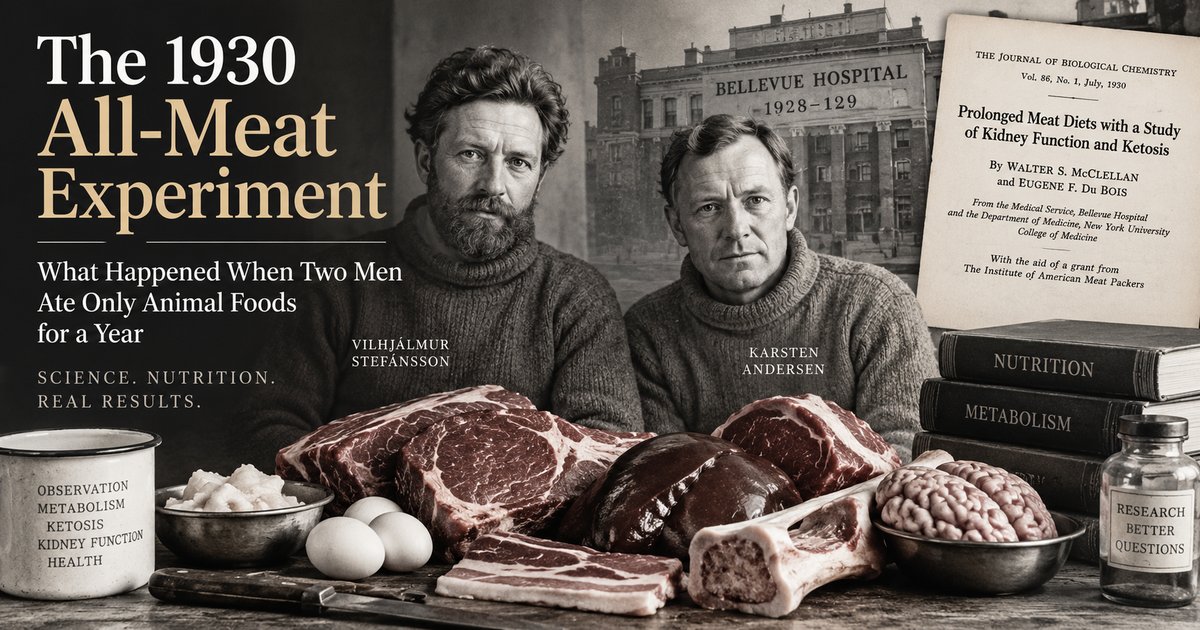
In 1928, Arctic explorer Vilhjálmur Stefánsson agreed to put one of his most controversial claims to a scientific test.
For years, Stefánsson had told physicians and nutritionists that during his Arctic expeditions he had lived for extended periods almost entirely on animal foods and remained healthy.
That assertion collided with conventional nutritional thinking.
Surely, critics argued, a diet without fruits, vegetables, grains, or other plant foods would eventually produce vitamin deficiencies, digestive problems, kidney damage, or some other obvious sign of nutritional failure.
Rather than continue debating the question, Stefánsson volunteered to become the experiment.
He and fellow Arctic explorer Karsten Andersen agreed to eat essentially nothing but animal foods for an entire year while physicians associated with Bellevue Hospital in New York studied what happened.
The research culminated in a 1930 paper by Walter S. McClellan and Eugene F. Du Bois titled Prolonged Meat Diets with a Study of Kidney Function and Ketosis.
Its conclusion was surprisingly uneventful.
After a year, the researchers could find no evidence that the diet had produced significant harm in either man.
That does not prove that everyone should eat an all-meat diet.
But almost a century later, the experiment remains difficult to reconcile with the claim that humans necessarily become sick simply because plants disappear from the diet.
Stefánsson Had Already Run the Experiment on Himself
This was not Stefánsson’s first exposure to a meat-heavy diet.
He had spent more than eleven years exploring the Arctic. During substantial portions of those years, he reported living almost exclusively on animal foods.
Andersen had also spent years on Arctic expeditions.
Stefánsson’s experience had convinced him that what mattered was not simply eating “meat.”
It was eating enough fat.
That distinction would become one of the most interesting findings of the Bellevue experiment.
The researchers moved the men from an ordinary mixed diet onto an animal-only diet while conducting metabolic, urinary, blood, kidney-function, and clinical observations.
Stefánsson ultimately completed 375 days on the diet.
Andersen completed 367 days.
Parts of the experiment were performed under intensive observation in Bellevue’s metabolism ward. During other periods, the men lived outside the hospital and returned for examinations and testing.
So this was not a modern randomized controlled trial, nor were the men locked in a laboratory for 365 consecutive days.
But neither was it simply Stefánsson telling people what he claimed to have eaten.
Researchers repeatedly examined them and collected objective laboratory data.
“Meat” Did Not Mean Lean Steak
This is probably the most important fact about the experiment.
The diet was not primarily protein.
The foods included beef, lamb, veal, pork, and chicken. The men ate muscle meat, but they also consumed liver, kidney, brain, bone marrow, bacon, and animal fat.
Their typical daily intake was approximately:
- 100–140 grams of protein
- 200–300 grams of fat
- 7–12 grams of carbohydrate
- 2,000–3,100 calories
Between approximately 75 and 85 percent of their calories came from fat, while only 15–25 percent came from protein.
Carbohydrate accounted for roughly 1–2 percent.
By modern terminology, this was an extremely low-carbohydrate ketogenic diet composed almost entirely of animal foods.
Calling it a “high-protein diet” badly misrepresents what they actually ate.
And the researchers demonstrated why almost immediately.
Stefánsson Got Sick When They Took Away the Fat
Early in the experiment, the researchers asked Stefánsson to eat very lean meat.
He had already warned them that very lean meat had caused problems during his Arctic experience.
They tried it anyway.
Within several days, Stefánsson developed nausea and diarrhea.
Fatty meat was added back to the diet.
His symptoms disappeared.
The researchers later noted that digestive problems appeared when protein climbed to roughly 40 percent or more of total calories.
This episode is frequently associated with what is sometimes called rabbit starvation or protein poisoning.
Humans can consume substantial amounts of protein, but there appears to be a practical limit to how much of our energy requirement can comfortably come from protein alone.
Stefánsson had already learned this in the Arctic.
The Bellevue experiment reproduced the lesson in a matter of days.
The animal-only diet that worked was not:
lean meat + more lean meat.
It was:
moderate protein + substantial animal fat.
That distinction gets lost in many modern discussions of the experiment.
What Happened to Their Weight?
Both men initially lost weight.
Stefánsson lost roughly 2 kilograms during his first week, while Andersen lost approximately 1 kilogram.
The investigators believed much of the early decline was associated with changes in body water following the abrupt reduction in carbohydrate intake.
After the initial adjustment, their weights became relatively stable.
Anyone familiar with very-low-carbohydrate diets will recognize the pattern: a rapid initial reduction in body weight followed by much slower changes once glycogen and associated water losses have largely occurred.
Researchers were observing the phenomenon nearly a century ago.
What About Their Blood Pressure?
Blood pressure did not increase.
One man’s blood pressure remained essentially unchanged, while the other’s systolic pressure fell by approximately 20 mmHg during the experiment.
Two people obviously cannot establish that eating meat lowers blood pressure.
But that was not the important finding.
The significance was that a year of eating almost entirely animal foods did not produce the obvious hypertension some critics expected.
Another predicted consequence failed to materialize.
What About Their Kidneys?
Another concern was that prolonged meat consumption would damage kidney function.
The researchers examined urine, measured nitrogen-related compounds in the blood, and performed the kidney-function tests available at the time.
Their conclusion was straightforward:
“Kidney function tests revealed no evidence of kidney damage.”
That statement requires some qualification.
The investigators did not possess modern biomarkers, advanced medical imaging, or decades of follow-up.
They also did not perform kidney biopsies looking for microscopic structural changes.
The experiment therefore cannot establish that an animal-only diet is incapable of damaging kidneys under any circumstances.
It establishes something narrower:
After approximately one year, the physicians could find no clinical or laboratory evidence that the diet had damaged the kidneys of these two men.
That is a much more defensible conclusion.
And Then There Was Scurvy
Perhaps the most obvious predicted problem was vitamin deficiency.
Humans cannot synthesize vitamin C.
A diet without fruits and vegetables would therefore seem to make scurvy inevitable.
Yet after a year, neither man developed it.
The researchers summarized the result simply:
“Vitamin deficiencies did not appear.”
This should not be interpreted as evidence that humans do not require vitamin C.
We do.
The more interesting question is how much vitamin C is required under different dietary conditions and how much can be obtained from fresh animal tissues.
The Bellevue diet also differed considerably from eating nothing but heavily cooked supermarket steak.
The men consumed organs, marrow, and a variety of animal tissues. Some foods were eaten lightly cooked, and bone marrow was sometimes consumed raw.
The experiment therefore does not establish that every possible version of an animal-only diet prevents scurvy.
It demonstrates that their version did.
And it did so for approximately a year.
They Were in Ketosis
Carbohydrate consumption generally remained under about 12 grams per day.
Unsurprisingly, both men produced ketone bodies.
The researchers detected ketones throughout the exclusive-meat portions of the experiment.
Yet they observed no mental impairment or clinical illness they could attribute to this prolonged ketosis.
The investigators specifically reported no apparent depression of mental faculties or other obvious injury resulting from the ketotic state.
Today we routinely distinguish nutritional ketosis from diabetic ketoacidosis.
In 1930, researchers were already documenting that sustained ketosis in metabolically healthy people did not automatically represent a pathological condition.
They Didn’t Become Weak or Lethargic
At the conclusion of the experiment, McClellan and Du Bois described both men as mentally alert and physically active.
They reported no subjective or objective evidence of decreased physical or mental vigor.
The men’s teeth also showed no obvious deterioration.
Stefánsson’s existing gingivitis reportedly improved, although tartar accumulation increased.
Bowel function remained generally normal once the early problems caused by excessive lean protein were corrected.
None of this demonstrates that removing plants cures gingivitis, improves digestion, or enhances physical performance.
There were only two subjects.
The important observation is much narrower.
The obvious physical deterioration that critics expected simply did not occur.
One Result Should Not Be Ignored
Blood lipids are where the experiment becomes especially interesting.
During periods of particularly high fat consumption, the researchers observed lipemia—an unusually high concentration of fat circulating in the blood.
Their cholesterol measurements varied substantially and, at certain points associated with visible lipemia, became extremely high by modern numerical standards.
Those measurements cannot simply be interpreted as if they came from a modern fasting lipid panel.
Laboratory methods, terminology, sampling conditions, and our understanding of lipoproteins have changed dramatically since 1930.
Still, the finding cannot simply be dismissed.
More importantly, the researchers themselves acknowledged a major limitation:
They had no way to determine whether changes were developing inside the subjects’ arterial walls.
This is precisely where the experiment’s conclusions have to stop.
It can tell us that neither man showed obvious clinical deterioration after approximately one year.
It cannot tell us what would have happened after 10, 20, or 40 years.
The Research Was Partly Funded by the Meat Industry
There is another detail worth including because leaving it out would be misleading.
The research received financial support in part from the Institute of American Meat Packers.
That does not automatically invalidate the experiment.
Industry funding does not make research false any more than government or nonprofit funding automatically makes research correct.
The relevant questions remain:
- Were the methods reasonable?
- Were the observations accurately reported?
- Were limitations disclosed?
- Do the conclusions follow from the evidence?
But funding sources are legitimate context.
The authors disclosed theirs.
What the Experiment Proved—and What It Didn’t
The strongest criticism of the Bellevue experiment is also the most obvious:
There were only two long-term subjects.
They were not representative of the general population.
Both had substantial previous experience eating this way.
There was no randomized control group.
Cardiovascular disease develops over decades rather than months.
Modern micronutrient testing did not exist.
Modern lipoprotein analysis did not exist.
Neither coronary calcium scoring nor modern vascular imaging nor today’s kidney biomarkers were available.
Calling this definitive evidence that a carnivore diet is the optimal human diet would be unjustified.
But dismissing the experiment because it included only two subjects also misses why it remains important.
The researchers were not trying to answer the enormous question:
What is the statistically optimal diet for the entire human population?
They were testing a much simpler proposition:
Can human beings live for a prolonged period on essentially animal foods alone without rapidly developing obvious nutritional disease?
For these two men, the answer was yes.
That matters because considerably stronger claims are sometimes made in the opposite direction—that eliminating plants must necessarily produce vitamin deficiencies, kidney damage, digestive dysfunction, weakness, or some other predictable physiological breakdown.
Those things were expected.
They didn’t happen.
Sometimes the Negative Result Is the Interesting Result
At the conclusion of their work, McClellan and Du Bois reported that their clinical observations and laboratory studies provided no evidence that the prolonged exclusive-meat diet had produced significant ill effects in these experienced subjects.
That is considerably more restrained than saying:
Meat is the perfect human diet.
But it is also much more interesting than saying:
They survived.
They did more than survive.
After approximately a year on an extraordinarily restrictive diet containing almost no carbohydrate and virtually no plant foods, researchers examining them with the medical tools available at the time could identify no specific physical deterioration attributable to the diet.
The most dramatic problem Stefánsson experienced occurred when the researchers temporarily ignored what he had already learned in the Arctic and gave him too much lean meat and too little fat.
Correct the ratio, and the problem disappeared.
Nearly a century later, the Bellevue experiment cannot settle modern arguments about saturated fat, LDL cholesterol, cardiovascular disease, longevity, or optimal nutrition.
It was never capable of doing that.
What it accomplished was simpler.
Two men made an extraordinary nutritional claim.
Scientists put that claim to a year-long test.
And the catastrophic outcome many people expected never arrived.