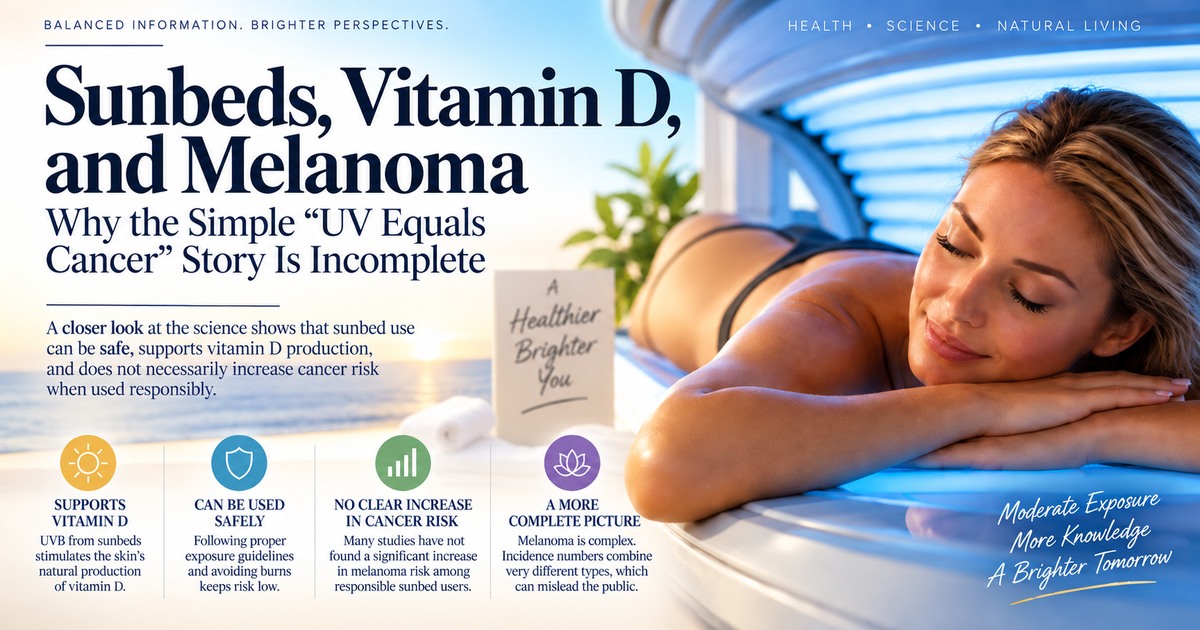
The public discussion around ultraviolet light is usually reduced to a simple equation:
UV exposure causes melanoma. Therefore, less UV exposure is always better.
That message is easy to communicate. It is also incomplete.
Ultraviolet radiation can damage skin, cause sunburn, accelerate skin aging, injure the eyes, and contribute to skin cancer. None of that is seriously disputed.
But acknowledging that excessive UV exposure can cause harm does not establish that every exposure carries the same risk. A carefully controlled, non-burning exposure is not biologically identical to repeated sunburn. Different melanoma subtypes do not necessarily arise through the same pathways. And UV exposure produces physiological effects—including vitamin D production—that make the idea of “zero UV is best” difficult to defend as a universal principle.
The useful question is not whether UV can be harmful.
It is how much UV, delivered how often, to what type of skin, under what conditions, and with what biological result?
Exposure Is Not the Same Thing as Overexposure
Humans have been exposed to sunlight throughout our entire existence.
UV radiation is therefore not an environmental substance for which the normal human exposure level is zero. It is a natural input that produces both beneficial and harmful biological effects.
The clearest example of excessive exposure is sunburn.
A recurring pattern in melanoma research is that intense intermittent exposure and burning appear considerably more important than ordinary, chronic exposure.
Large analyses of sun exposure have found strong associations between sunburn and melanoma while finding little or no increase associated with more continuous sun exposure. Some research has even reported an inverse association with regular chronic exposure.
That distinction matters enormously.
Consider two people classified in a study as having “used a tanning bed.”
One follows an exposure schedule appropriate for his skin type, gradually develops a tan, and never burns.
The second repeatedly stays under the lamps long enough to redden or burn the skin.
An epidemiological study may place both people in exactly the same category:
Ever used a tanning device.
Yet those are clearly not the same biological exposure.
One investigation that was able to separate tanning-device users who burned from those who did not found no significant increase in melanoma among users who did not burn, while the group that experienced burns showed substantially greater risk.
That does not prove that non-burning UV exposure carries zero risk.
It does demonstrate why sunburn cannot simply be removed from the equation.
The Problem With “Ever Used a Sunbed”
Much of the indoor-tanning literature relies on exposure categories that are surprisingly crude.
Researchers may ask whether someone ever used a tanning device, how many sessions they remember having, or approximately how old they were when they first used one.
But “indoor tanning” can include very different exposures:
- A modern commercial tanning bed used according to a skin-type exposure schedule.
- An unsupervised tanning bed at home.
- Older sunlamps.
- Tanning equipment with different UVA-to-UVB ratios.
- Repeated sessions that never cause erythema.
- Sessions that regularly produce burns.
Combining all of those exposures into one variable makes it difficult to determine what is actually responsible for any observed association.
This becomes particularly interesting because some analyses have found different results for commercial tanning facilities and home tanning devices.
In some datasets, commercial tanning was not associated with a statistically significant increase in melanoma, while home tanning was.
That difference deserves attention.
If merely being exposed to artificial UV were the entire mechanism, the location of the device should matter very little.
A more plausible explanation is that dose control matters.
An unsupervised home user can simply stay under the lamps too long. A commercial system is designed around exposure schedules intended to reduce the chance of burning.
That does not make commercial tanning risk-free.
It does mean that the question should be more sophisticated than:
“Have you ever used a tanning bed?”
A far more useful set of questions would be:
What was the dose? What was the spectrum? How frequently was it used? What was the person’s skin type? And did the exposure produce a burn?
Large Studies Have Not Always Found Increased Melanoma Risk
The epidemiological evidence surrounding sunbeds is more mixed than most public discussions suggest.
A large UK case-control study examined nearly a thousand people with melanoma and compared them with population and sibling controls.
After adjusting for factors including age, sex, sun sensitivity, family history, education, and cumulative lifetime sun exposure, the researchers found no statistically significant increase in melanoma associated with ever having used a sunbed.
They also did not find a clear trend showing melanoma risk increasing as the number of lifetime tanning sessions increased.
The researchers did not conclude that tanning was proven harmless. They acknowledged that a small effect could have gone undetected and that early-life exposure might behave differently.
That qualification is important.
Failing to detect an increased risk is not the same thing as proving zero risk.
But the reverse is also true:
A small observational association does not automatically prove that the exposure caused the disease.
The Missing Dose-Response Relationship Matters
One of the things epidemiologists look for when evaluating whether an exposure causes disease is a dose-response relationship.
If an exposure independently causes a disease, we frequently expect greater exposure to correspond to progressively greater risk.
That pattern has not appeared consistently in sunbed studies.
In the UK research, people with more lifetime sessions did not demonstrate a statistically significant increasing trend in melanoma compared with nonusers.
Again, that does not prove safety.
But it raises an important question about the simplest version of the prevailing theory.
If every tanning session independently adds melanoma risk, why is the relationship between cumulative sessions and melanoma not clearer?
The answer may be that the relevant variable is not merely number of sessions.
It may include burning, genetic susceptibility, natural sun exposure, age, skin phenotype, and the type of melanoma that eventually develops.
Sunbeds Can Produce Vitamin D
There is another side of UV exposure that often receives remarkably little attention.
UVB radiation stimulates vitamin D production in human skin.
This is basic human physiology.
When UVB reaches the skin, it initiates the conversion of 7-dehydrocholesterol into previtamin D3, beginning the process that eventually contributes to circulating vitamin D levels.
Sunlight does this.
A tanning device containing UVB can do it as well.
The amount of vitamin D produced will vary considerably depending on the lamp spectrum, exposure duration, skin pigmentation, age, body surface exposed, and existing vitamin D status.
But the underlying mechanism is not controversial.
This matters because UV is often described to the public purely as a carcinogenic hazard, as if the human body has no physiological use for it.
In reality, the body uses part of the UV spectrum to perform an important biological function.
Vitamin D Complicates the Melanoma Story
The relationship between vitamin D and melanoma makes the picture even more interesting.
A case-control study comparing melanoma patients with healthy controls found substantially lower vitamin D levels among the melanoma patients.
The median vitamin D level in the melanoma group was about 18 ng/mL, compared with nearly 28 ng/mL in the control group.
Vitamin D deficiency was also dramatically more common among the melanoma patients.
After adjustment for age, sex, and body mass index, higher vitamin D levels were strongly associated with lower melanoma odds in that particular dataset.
That does not prove that vitamin D prevents melanoma.
Case-control studies cannot establish the direction of causality. Low vitamin D might contribute to poor health, result from different behavior, reflect other biological differences, or simply act as a marker.
But it does challenge the simplistic assumption that avoiding UV as much as possible must automatically produce the best health outcome.
The actual relationship appears considerably more complicated.
Melanoma Is Not One Disease
Another major problem with broad claims about “melanoma” is that melanoma is not a single homogeneous disease.
The major cutaneous forms include:
- Superficial spreading melanoma
- Nodular melanoma
- Lentigo maligna melanoma
- Acral lentiginous melanoma
These tumors differ in their growth patterns, typical locations, biological behavior, prognosis, and relationship to ultraviolet exposure.
Superficial spreading melanoma represents the majority of cases and often grows horizontally for some time before becoming deeply invasive.
Nodular melanoma is less common but tends to grow vertically and become invasive much more rapidly.
Lentigo maligna melanoma is closely associated with chronically sun-exposed skin.
Acral lentiginous melanoma commonly develops on the soles, palms, and beneath the nails—areas that normally receive little ultraviolet exposure—and is generally not considered a UV-driven melanoma.
That alone demonstrates that melanoma can occur through pathways that do not depend upon ordinary sunlight exposure.
It would be equally wrong, however, to claim that the more dangerous melanoma forms are generally caused by a lack of sunlight. The evidence does not support that conclusion.
The meaningful point is that different melanomas should not automatically be treated as if they have identical causes.
“Melanoma Cases Are Increasing” Does Not Tell the Whole Story
This brings us to one of the biggest problems in public communication about melanoma:
The number.
People routinely hear that the number of melanoma diagnoses is increasing.
That sounds frightening.
But incidence alone does not tell us how dangerous the actual disease burden is.
A melanoma detected while confined to the outer layer of the skin is very different from a deeply invasive melanoma.
A very thin localized melanoma is very different from metastatic disease.
Even among invasive melanomas, prognosis differs dramatically according to tumor thickness, stage, subtype, ulceration, and whether the cancer has spread.
Yet public discussions frequently collapse all of this complexity into one statistic:
Cases of melanoma.
That number does not tell the public:
How many lesions were melanoma in situ?
How many were very thin invasive tumors?
How many were aggressive nodular melanomas?
How many were metastatic?
Did the average tumor thickness increase?
Did advanced disease increase?
Did mortality increase proportionally?
Those questions paint a much more meaningful picture than incidence alone.
Diagnosis and Danger Are Not the Same Statistic
Modern medicine is also much better at detecting small skin abnormalities than it was decades ago.
People receive more skin examinations.
Dermatologists use dermoscopy.
Patients photograph and monitor lesions.
Suspicious moles are biopsied.
High-risk patients may undergo repeated surveillance.
This is beneficial when a genuinely dangerous melanoma is identified earlier.
But increased surveillance can also increase the number of diagnosed early lesions.
Consequently, a rising incidence curve does not necessarily mean that lethal melanoma is rising at exactly the same rate.
This is why incidence, tumor thickness, stage, metastatic disease, and mortality should be examined together.
If diagnoses rise dramatically while deaths rise only modestly—or not at all—that tells a different story from a proportional increase in advanced and lethal melanoma.
Early melanoma should absolutely be taken seriously.
But the raw number of diagnoses should not automatically be treated as a measurement of how much deadly melanoma exists in the population.
Melanoma Can Occur Without an Obvious Outside Trigger
Melanoma is also not necessarily the result of one identifiable external event.
Cancer ultimately results from genetic alterations that allow cells to grow abnormally.
Some of those mutations can be inherited.
Others arise through normal DNA-replication errors, aging, immune-system changes, or environmental damage.
UV exposure can clearly contribute to that process in many melanomas.
But it is not required for every melanoma.
Acral melanoma is the most obvious example.
It occurs in places such as the soles of the feet and beneath fingernails and toenails, demonstrating that melanocytes can become cancerous even in areas receiving essentially no routine sunlight.
That does not mean melanoma is inevitable with aging. Most people will never develop it.
It does mean that the existence of a melanoma in someone who has been exposed to sunlight does not, by itself, establish that sunlight caused that individual tumor.
Population-level causation requires considerably more evidence.
Sunscreen Adds Another Layer of Complexity
Sunscreen introduces an interesting behavioral complication.
Sunscreen is intended primarily to reduce UV reaching the skin and prevent burning.
But sunscreen can also alter behavior.
A Swedish case-control study found that regular sunscreen users reported more sun exposure than nonusers.
The researchers also observed a higher melanoma association among regular sunscreen users, with a particularly large association among people who specifically said sunscreen allowed them to stay in the sun longer.
That does not mean the sunscreen ingredients themselves caused melanoma.
The researchers believed the result was largely explained by behavioral compensation and the relatively weak sunscreens commonly used at the time.
But that finding is extremely important.
A person without sunscreen may spend 20 or 30 minutes in intense sunlight and then leave because the skin begins signaling that the exposure is excessive.
A person wearing sunscreen may remain outside for several hours because the sunscreen suppresses the visible warning sign of burning.
The second person may therefore accumulate considerably more total UV exposure.
The lesson is not that sunscreen is inherently harmful.
It is that a protective measure should not become permission to ignore dose.
Again, exposure pattern matters.
The Objective Should Be Preventing Overexposure, Not Fearing Light
There is an important philosophical difference between these two messages:
Prevent excessive UV exposure and avoid sunburn.
and
Avoid sunlight whenever possible.
Those are not the same recommendation.
The first is fundamentally about dose management.
The second can gradually turn sunlight itself into something people are taught to fear.
That distinction matters because UV exposure is not biologically neutral. It participates in vitamin D production and other physiological processes.
A sensible approach to UV therefore should not begin from the assumption that the optimal exposure is always zero.
It should begin with the question of how to obtain the benefits of reasonable exposure while minimizing the harm of excessive exposure.
“Carcinogenic” Does Not Mean Every Exposure Has the Same Risk
Ultraviolet radiation is correctly classified as carcinogenic.
But the word carcinogen is frequently misunderstood.
A carcinogenic classification means that an agent is capable of causing cancer under some conditions and at some level of exposure.
It does not mean that every exposure carries an identical cancer risk.
Sunlight itself illustrates the point perfectly.
Enough sunlight to repeatedly burn someone’s skin is clearly harmful.
A few minutes of ordinary exposure is not biologically equivalent to a severe burn.
The same principle applies to artificial UV.
A tanning session that produces erythema is evidence that the exposure exceeded the skin’s tolerance.
A carefully limited session that does not burn the skin is a different event.
That distinction deserves considerably more attention than it usually receives.
So Are Sunbeds Safe?
“Safe” is probably the wrong word because it implies zero risk.
Sunbeds expose the skin to ultraviolet radiation, and ultraviolet radiation is capable of producing DNA damage.
No responsible argument should claim that tanning beds are completely harmless.
But the opposite claim—that every controlled tanning session materially increases melanoma risk—is also stronger than the evidence can establish.
Some substantial studies have failed to find a statistically significant melanoma increase among sunbed users.
Some have failed to demonstrate a clear dose-response relationship.
Some research suggests that burns are an important confounding factor.
Studies separating commercial and home tanning have sometimes produced substantially different results.
And commercial tanning that follows appropriate exposure schedules is fundamentally designed around one important objective:
Do not burn the customer.
That makes moderate, non-burning tanning a much more nuanced risk question than the usual slogan suggests.
The Better Way to Think About UV
There are two overly simplistic positions.
One says:
UV causes cancer, so all UV exposure should be minimized.
The other says:
UV produces vitamin D, so UV exposure cannot be harmful.
Neither is satisfactory.
A more evidence-based position recognizes several things simultaneously.
UV exposure can cause damage.
Sunburn is particularly undesirable.
UVB stimulates vitamin D production.
Different patterns of UV exposure appear to carry different risks.
Different melanoma subtypes arise through different biological pathways.
Some melanoma occurs without meaningful UV exposure.
Raw melanoma incidence does not tell us the stage, thickness, subtype, or lethality of the diagnosed tumors.
And behavioral strategies intended to protect against UV can sometimes change people’s behavior in ways that increase total exposure.
The useful questions are therefore not:
“Is UV good?”
or
“Is UV bad?”
They are:
How much?
How often?
What wavelengths?
What skin type?
Was there a burn?
At what age?
What kind of melanoma are we talking about?
Was the tumor in situ, thin and localized, deeply invasive, or metastatic?
And what happened to mortality—not merely to the number of diagnoses?
Once those questions are asked, the simplistic idea that all UV exposure should be feared becomes much harder to defend.
A more rational principle emerges:
Avoid overexposure. Avoid burning. Understand your individual risk. But do not confuse responsible UV exposure with UV injury.