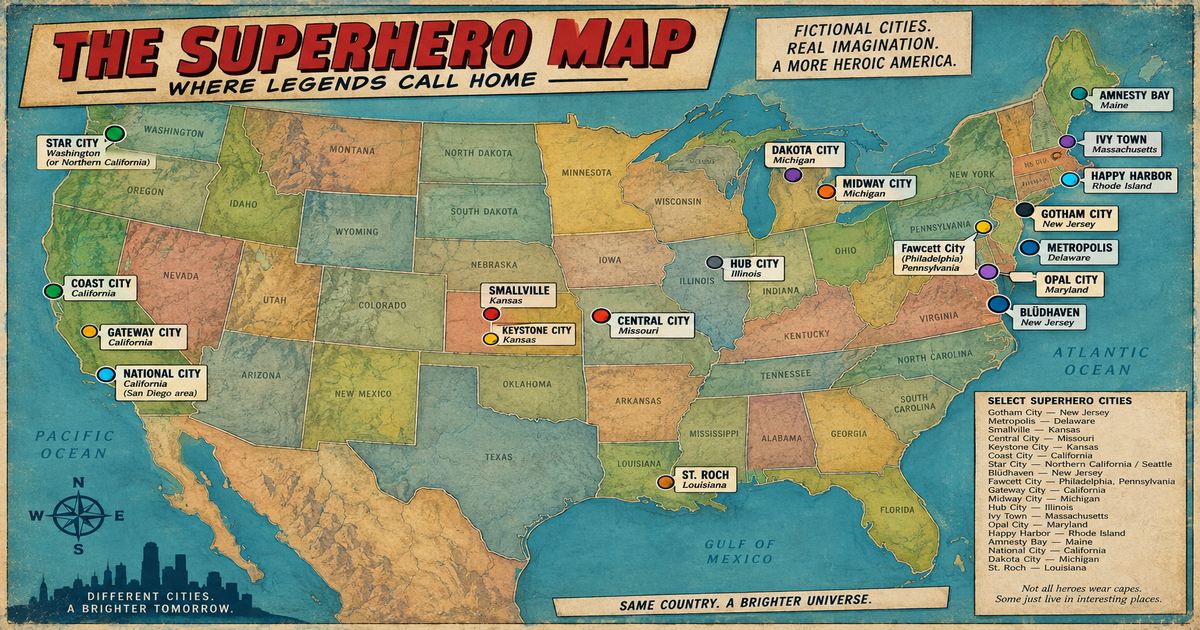
If you grew up reading comic books, you probably absorbed a strange version of American geography without ever really thinking about it.
Batman lives in Gotham City.
Superman works in Metropolis but grew up in Smallville.
The Flash runs around Central City.
Green Lantern protects Coast City.
Green Arrow operates out of Star City.
Nightwing moved to Blüdhaven.
The problem is that you cannot open Google Maps and find most of these places.
Comic books—particularly DC Comics—have created an entire shadow geography of the United States. Fictional cities have been inserted between real ones, sometimes occupying areas where actual cities should be and sometimes changing locations depending on the writer, era, television show, movie or continuity.
So where exactly are all these places supposed to be?
The answer is surprisingly complicated.
Gotham City — New Jersey
Batman’s Gotham City is culturally associated with New York City, and that is no accident. Gotham itself was already an old nickname for New York, and Batman’s earliest adventures were essentially set in a fictionalized version of New York.
But within DC’s fictional geography, Gotham is most commonly placed in New Jersey.
Various DC sources over the decades have put Gotham somewhere along the southern New Jersey coast. The 1990 Atlas of the DC Universe reinforced the New Jersey location, and other stories have placed Gotham within reasonable driving distance of Atlantic City and the Jersey Shore.
Visually, of course, Gotham has borrowed from several real cities.
New York supplied much of the original DNA. Chicago has heavily influenced its appearance in movies. Other versions have borrowed industrial elements from places such as Pittsburgh and Detroit.
But if Bruce Wayne had to put a state on his tax return, New Jersey is probably the safest answer.
Metropolis — Delaware… Probably
Superman’s Metropolis is much harder to pin down.
Creators Jerry Siegel and Joe Shuster originally drew inspiration from their hometown of Cleveland. Later depictions increasingly resembled New York City.
Within DC geography, however, one of the most persistent arrangements puts Metropolis in Delaware, on the opposite side of Delaware Bay from Gotham City.
That creates one of the strangest facts in superhero geography:
Batman and Superman may live only a few dozen miles apart.
Gotham occupies the New Jersey side of the region while Metropolis occupies the Delaware side.
DC itself has described versions of the geography in which the two cities are roughly thirty miles apart, although actually driving between them could require going around the bay.
Metropolis has also been placed in New York or otherwise shifted around in various continuities, and the television series Smallville effectively moved it much closer to Kansas.
So there is no universally correct answer.
But the classic comic-book arrangement of Gotham in New Jersey and Metropolis in Delaware makes the overall DC geography fit together surprisingly well.
Smallville — Kansas
At least Superman’s hometown is easier.
Smallville is in Kansas.
Interestingly, this was not firmly established from Superman’s beginning. Smallville was originally more of an idealized American farming town than a specific location.
The 1978 Superman movie strongly associated the Kent farm with Kansas, and John Byrne’s 1986 The Man of Steel incorporated Kansas into the modern comic continuity.
Smallville therefore occupies the fictional rural Kansas landscape somewhere far from Clark Kent’s eventual life in Metropolis.
It is essentially the mythological American heartland: farms, grain silos, high-school football and endless fields surrounding a town where absolutely nothing unusual should happen.
Except, of course, an alien spacecraft crashing into one of those fields.
Central City — Missouri
The home of Barry Allen, the Flash, is Central City, Missouri.
But there is a clever geographic trick involved.
Across the Missouri River sits another fictional city:
Keystone City, Kansas.
The two cities function as twin cities sitting on opposite sides of the Kansas-Missouri border.
That should sound familiar.
DC essentially created an exaggerated superhero version of the real Kansas City arrangement, where Kansas City, Missouri and Kansas City, Kansas sit on opposite sides of the state line.
Barry Allen is primarily associated with Central City, while Jay Garrick and later Wally West have strong connections to Keystone City.
The result is effectively one enormous Flash metropolitan area divided between two states.
Coast City — California
Green Lantern Hal Jordan’s hometown is Coast City, and at least the state is reasonably consistent:
California.
Exactly where in California is another matter.
Some DC material has placed Coast City in Northern California near San Francisco, while other stories have pushed it farther south.
Southern California arguably makes considerable sense for Hal Jordan.
Jordan is a test pilot associated with Ferris Aircraft, so putting Coast City near the aerospace and military aviation culture of Southern California fits the character perfectly.
Think beaches, aerospace companies, test pilots and considerably more extraterrestrial activity than the average California coastal city.
Star City — California… or Seattle
Green Arrow’s Star City has moved around even more.
Historically, Star City was usually portrayed as a West Coast city, with several sources placing it in Northern California.
That made it something of a fictional San Francisco.
But Oliver Queen has also spent substantial portions of his comic-book life in Seattle, Washington.
Eventually DC found ways to blur or reconcile the two ideas, and some modern versions have associated Star City directly with Seattle.
So depending on which period you are reading, Green Arrow may live in fictional Northern California or essentially in Seattle.
Blüdhaven — New Jersey
When Dick Grayson finally moved away from Batman’s shadow, he did not go particularly far.
Nightwing’s city, Blüdhaven, is generally located in New Jersey, somewhere in the same broader region as Gotham.
That means the fictional DC version of New Jersey is remarkably crowded.
In addition to all the real cities and towns, it somehow has room for Gotham City and Blüdhaven—two significant metropolitan areas with truly astonishing crime problems.
Blüdhaven was intentionally created as a city even rougher and more economically damaged than Gotham.
Apparently New Jersey needed another vigilante.
Fawcett City — Philadelphia
Captain Marvel—the superhero now generally called Shazam—historically lived in Fawcett City.
The name was a tribute to Fawcett Comics, the company that originally published Captain Marvel before the characters eventually became part of DC.
Older stories moved Fawcett City around, with different continuities treating it differently.
Modern DC continuity has taken another approach, associating Fawcett City with Philadelphia, Pennsylvania.
That is actually an elegant solution.
Instead of inventing another enormous American metropolis, DC can effectively insert Fawcett City into the landscape of an existing city.
Gateway City — California
Wonder Woman has lived in several places depending on the era, including Washington, D.C., Boston and, naturally, Themyscira.
During the 1990s, however, she became closely associated with Gateway City.
Gateway City is in California and has often visually resembled San Francisco, making Northern California the natural comparison.
Wonder Woman therefore adds yet another fictional metropolis to California’s already crowded coastline.
Midway City — Michigan
Hawkman and Hawkgirl have been associated with Midway City, another fictional American metropolis.
Visually, Midway City was originally influenced by Chicago.
Geographically, however, DC sources have generally placed it in Michigan.
This is a recurring trick in comic books: borrow the visual identity of a recognizable real city, then move the fictional version somewhere else.
Hub City — Illinois
The Question is most closely associated with Hub City.
Writer Dennis O’Neil drew inspiration from economically troubled Midwestern cities when developing it, and DC geography has placed Hub City in Illinois.
Hub City is deliberately unpleasant.
Crime, political corruption, poverty and institutional decay are practically part of the scenery, providing exactly the kind of environment in which a faceless investigative vigilante like the Question makes sense.
Ivy Town — Massachusetts
The Atom—both Ray Palmer and Ryan Choi—has been closely associated with Ivy Town.
As the name suggests, Ivy Town is primarily a university community.
DC has placed it in Massachusetts, essentially making it part of the fictional landscape of New England’s university corridor.
Imagine Cambridge if someone accidentally invented technology capable of shrinking human beings to microscopic size.
Opal City — Maryland
One of DC’s most distinctive fictional locations is Opal City, best known as the home of Starman.
Unlike the gloomy industrial architecture of Gotham, Opal City has often been portrayed as elegant, historic and architecturally beautiful.
It is generally placed in Maryland.
That puts yet another significant DC metropolis into the densely packed Mid-Atlantic region.
Happy Harbor — Rhode Island
The original Justice League once operated from a secret cave near Happy Harbor.
Happy Harbor is located in Rhode Island.
It later became important in Young Justice as well.
For such a tiny state, Rhode Island apparently has an unusually high concentration of superhero activity.
Amnesty Bay — Maine
Aquaman has Atlantis, but Arthur Curry also maintains connections to the surface world through Amnesty Bay, Maine.
It is the coastal community associated with the lighthouse of his father, Tom Curry.
Unlike many of DC’s invented megacities, Amnesty Bay is intentionally small: a quiet New England seaside town sitting above a world filled with Atlanteans, sea monsters and underwater kingdoms.
National City — California
Supergirl is commonly associated with National City.
Modern versions generally place it in California, often drawing from the real San Diego region.
That puts Kara Zor-El in Southern California while her cousin may be operating thousands of miles away in Metropolis.
Dakota City — Michigan
The heroes of the Milestone universe—including Static, Icon and Hardware—come largely from Dakota City.
Creator Dwayne McDuffie placed Dakota in Michigan, drawing significantly from his experiences growing up in Detroit.
Dakota eventually became part of the broader DC Universe, meaning Michigan now contains another fictional major city alongside Midway City.
St. Roch — Louisiana
Hawkman and Hawkgirl eventually gained another important home: St. Roch, Louisiana.
The city was introduced prominently during the modern Hawkman era and carries a distinctly Louisiana atmosphere.
Its architecture, culture and history help give Hawkman a setting very different from the generic skyscraper-filled superhero metropolis.
The DC United States Would Look Very Different
Put all these places together and DC’s America becomes a strange place.
The northeastern United States is particularly crowded.
New York still exists.
Philadelphia still exists.
Boston still exists.
Washington, D.C. still exists.
But now add Gotham, Metropolis, Blüdhaven, Fawcett City, Ivy Town, Opal City and several other fictional communities.
California becomes similarly packed with Coast City, Gateway City, National City and, depending on continuity, Star City.
The implication is that the United States of the DC Universe must have a substantially different urban population and geography than our own.
And that is before considering the number of cities that have been destroyed, evacuated, invaded by aliens, transported into other dimensions or attacked by giant monsters.
Property insurance must be unbelievable.
Marvel Took the Opposite Approach
Marvel largely avoided this problem.
Instead of inventing Gotham and Metropolis, Marvel famously placed many of its superheroes directly into the real world.
And by “the real world,” Marvel often means one particular place:
New York City.
Spider-Man grew up in Forest Hills, Queens.
Daredevil became synonymous with Hell’s Kitchen.
Doctor Strange lives in Greenwich Village.
The Fantastic Four traditionally operate from the Baxter Building in Manhattan.
The Avengers have repeatedly operated from Manhattan as well, including Avengers Mansion and Stark Tower.
Luke Cage, Jessica Jones, Iron Fist and numerous other street-level heroes are also strongly associated with New York.
This produces a completely different kind of fictional geography.
DC says:
“Imagine several enormous American cities that don’t exist.”
Marvel says:
“New York exists exactly where you think it does. It just has an absurd number of superheroes living there.”
Marvel’s Fictional Geography Is Mostly International
Marvel certainly has fictional locations. It just tends to put many of its most famous ones outside the continental United States.
Wakanda is a fictional African nation ruled by Black Panther.
Latveria is Doctor Doom’s fictional European country.
Genosha is a fictional island nation deeply connected with mutant history.
Madripoor is a fictional Southeast Asian island frequently associated with Wolverine, espionage and organized crime.
Atlantis exists beneath the ocean.
And the Savage Land somehow maintains a prehistoric ecosystem hidden in Antarctica.
Marvel therefore often preserves recognizable American geography while creating fictional nations and territories elsewhere in the world.
DC is much more willing to redraw the American map itself.
The Cities Are Really Characters
Trying to find the exact coordinates of Gotham or Metropolis eventually misses an important point.
These cities were never designed primarily as locations.
They were designed as ideas.
Gotham is the city at night.
It is old buildings, gargoyles, alleys, corruption, rain, organized crime and institutions that seem permanently broken.
Metropolis is the city during the day.
It is glass towers, technology, optimism, progress and the belief that tomorrow can be better than today.
That contrast is deliberate.
Both cities originated from real-world urban influences, but they represent two radically different interpretations of the modern American metropolis.
Smallville serves another purpose.
It is not simply somewhere in Kansas.
It represents rural America and the values Clark Kent carries with him when he becomes Superman.
Central City represents science, speed and technological optimism.
Coast City reflects aviation, aerospace and the Pacific Coast.
Star City gives Green Arrow a politically and economically complicated urban environment.
Blüdhaven gives Nightwing a place where he cannot simply rely on Batman.
The geography bends because the symbolism matters more than the map.
So Where Does Everyone Live?
If we reduce decades of contradictory continuity into something resembling a usable map, the major DC locations roughly work out like this:
| Location | Hero Most Associated With It | Approximate Location |
|---|---|---|
| Gotham City | Batman | New Jersey |
| Metropolis | Superman | Delaware / Northeast |
| Smallville | Superman | Kansas |
| Central City | Flash — Barry Allen | Missouri |
| Keystone City | Flash — Jay Garrick / Wally West | Kansas |
| Coast City | Green Lantern | California |
| Star City | Green Arrow | Northern California / Seattle |
| Blüdhaven | Nightwing | New Jersey |
| Fawcett City | Shazam | Philadelphia, Pennsylvania |
| Gateway City | Wonder Woman | California |
| Midway City | Hawkman / Hawkgirl | Michigan |
| Hub City | The Question | Illinois |
| Ivy Town | The Atom | Massachusetts |
| Opal City | Starman | Maryland |
| Happy Harbor | Justice League / Young Justice | Rhode Island |
| Amnesty Bay | Aquaman | Maine |
| National City | Supergirl | Southern California |
| Dakota City | Static / Icon / Hardware | Michigan |
| St. Roch | Hawkman / Hawkgirl | Louisiana |
None of this should be treated like surveying data.
Comic-book continuity changes.
Universes reboot.
Writers reinterpret locations.
Movies and television programs move cities to accommodate their own stories.
But there is enough consistency to draw a reasonably convincing map.
And once you do, one thing becomes obvious:
Batman really ought to call Superman for help more often.
Depending on which version of the DC map you use, he may practically be right across the water.