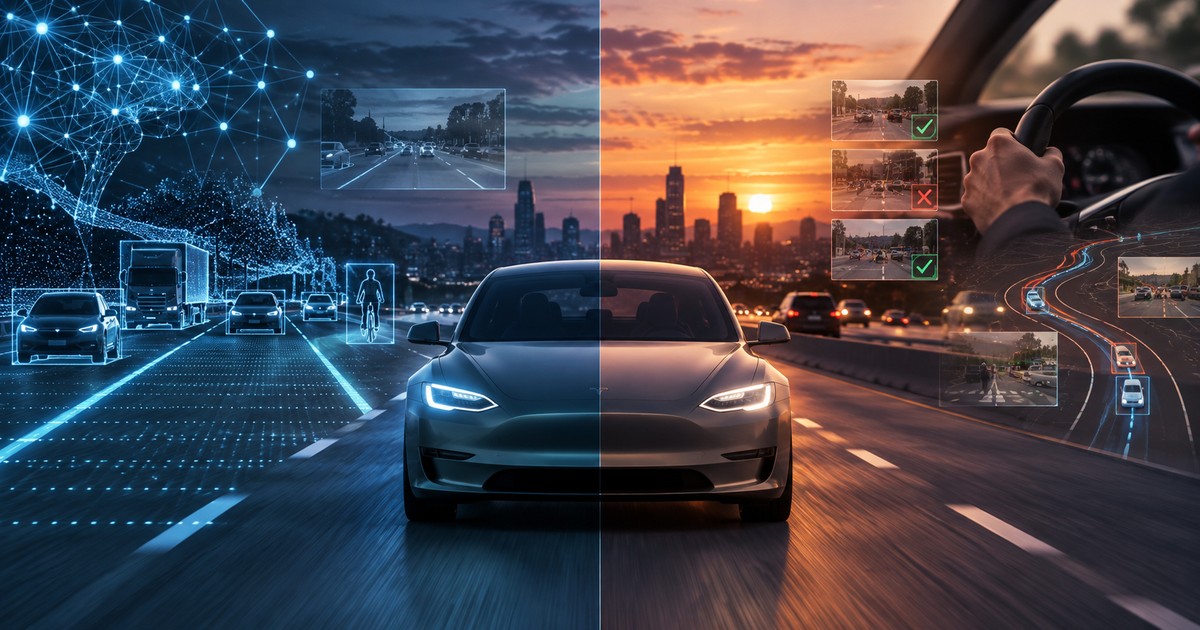
 Tesla’s Full Self-Driving system is artificial intelligence. It is also human-guided machine learning.
Those statements are not contradictory.
The confusion comes from the way the term “AI” is commonly used. Popular culture increasingly treats artificial intelligence as something resembling an independent mind—a system that understands the world, reasons about it, and makes decisions on its own.
That is not what the term means technically.
Machine learning is a branch of artificial intelligence, and modern Tesla Full Self-Driving is heavily based on machine learning. The more useful question is therefore not whether Tesla’s system is AI, but where the intelligence comes from and how independent the system really is from human behavior.
The answer is more interesting than either extreme.
Traditional Software Versus Machine Learning
Traditional software works primarily because programmers explicitly tell the computer what to do.
A simplified driving program might contain rules such as:
- If the traffic light is red, stop.
- If a vehicle is less than a certain distance ahead, slow down.
- If the navigation system says to turn right, enter the right lane.
- If the speed limit changes, adjust the maximum speed.
Real systems would obviously be much more complicated, but the basic architecture remains recognizable: engineers create rules, and the computer executes them.
Machine learning changes that relationship.
Instead of programming every driving behavior directly, engineers provide enormous amounts of data and allow neural networks to learn statistical relationships between what the vehicle sees and what an appropriate driving response should look like.
The engineers still design the system.
Humans still determine the objectives.
Humans still decide what data matters.
But humans do not necessarily write the rule that produces every individual steering, braking, or acceleration decision.
That difference is what makes modern Tesla FSD an AI system rather than simply an extremely complicated cruise-control program.
What Tesla’s Current System Actually Does
Tesla describes its current Full Self-Driving architecture as increasingly based on end-to-end neural networks.
That represents an important evolution from earlier autonomous-driving architectures.
A traditional autonomous-driving stack might be divided into separate components:
Cameras
   ↓
Object Detection
   ↓
Lane Detection
   ↓
Prediction
   ↓
Path Planning
   ↓
Vehicle Controls
Engineers could inspect and tune each stage individually.
An end-to-end neural-network architecture moves closer to:
Camera Video + Navigation + Context
                ↓
          Neural Network
                ↓
          Driving Actions
The network learns relationships between the visual world and appropriate driving behavior rather than requiring engineers to explicitly describe every possible situation in code.
That makes Tesla FSD fundamentally different from a giant decision tree.
But it also reveals where much of the system’s apparent intelligence originates.
Humans.
Tesla Is Learning to Drive From Humans
Imagine millions of drivers collectively demonstrating how to drive.
They navigate intersections.
They merge into traffic.
They move around parked vehicles.
They slow down when pedestrians approach a crosswalk.
They negotiate construction zones.
They encounter strange road layouts.
They react to drivers doing unpredictable things.
Tesla’s vehicle fleet can collect examples of these situations at a scale that would be practically impossible to create manually.
Tesla can then identify useful portions of that data for training.
Some examples may represent excellent driving behavior.
Others may reveal situations where FSD behaved incorrectly and a human driver intervened.
Others represent rare “edge cases” that the training system specifically needs more examples of.
Human data labelers can also annotate portions of the collected images and video so the training system has reliable information about what is occurring in a scene.
So there is unquestionably a large human component.
The car learns partly by studying us.
But the Car Is Not Simply Replaying Human Driving
This distinction matters.
Suppose thousands of Tesla drivers encounter four-way stop signs.
The neural network does not simply create a database containing:
At GPS coordinate X, wait 2.3 seconds and then turn left.
Instead, training modifies an enormous collection of numerical parameters inside the neural network.
Those parameters gradually encode statistical relationships between visual situations and successful driving behavior.
The resulting model may then encounter a four-way stop intersection it has never seen before.
It recognizes patterns resembling situations contained in its training experience and produces an appropriate response.
That ability to generalize beyond the exact examples contained in the training data is one of the defining characteristics of machine learning.
This is why describing Tesla FSD as nothing more than prerecorded human behavior would also be incorrect.
It is learning a model of driving behavior.
Humans Still Shape What the AI Learns
The impressive part happens inside the neural network, but humans remain deeply involved in creating the conditions that allow that learning to happen.
Humans decide which data should enter the training system.
Humans identify important edge cases.
Humans label portions of the training data.
Humans collect high-quality example drives.
Humans evaluate whether new versions perform better or worse.
Humans design the training objectives.
Humans decide which versions are safe enough to deploy.
Tesla has also described collecting high-quality manual driving examples specifically for training its end-to-end models.
So “human-guided machine learning” is actually a reasonable description.
It simply does not mean humans are secretly steering the car.
Training and Driving Are Two Different Things
This is perhaps the most important distinction.
There are two separate processes.
Training
Tesla collects data, selects examples, labels information, trains neural networks, evaluates models, and produces a set of neural-network parameters.
This process requires enormous computing infrastructure and substantial human involvement.
Inference
Once the trained model is installed in the vehicle, the Tesla receives live camera information and runs the neural network locally on its onboard computer.
The model evaluates the current situation and produces driving decisions.
There is not normally a Tesla employee sitting in a control center deciding:
Brake now.
Move three feet left.
Turn at the intersection.
The neural network is making those decisions in real time.
That is AI inference.
Human involvement occurred heavily during the creation and training of the system, but the resulting model executes independently inside the vehicle.
What About the Driver?
Tesla’s product name creates another source of confusion.
The current consumer product is called:
Full Self-Driving (Supervised).
The word “Supervised” does not mean that Tesla FSD exclusively uses a machine-learning technique called supervised learning.
It means the human driver must supervise the vehicle while it operates.
Current consumer FSD requires active driver supervision and does not make the vehicle fully autonomous.
The human driver is not normally generating the steering commands.
The neural network is.
The human is instead acting as the safety fallback.
If the AI makes a mistake, the driver is expected to recognize the problem and intervene.
That does not make the neural network less of an AI system.
It means the system has not been given complete operational responsibility.
AI and Autonomy Are Not the Same Thing
This exposes another common misconception.
A system can contain extremely sophisticated artificial intelligence without being fully autonomous.
Conversely, a machine can be autonomous without containing particularly sophisticated AI.
A thermostat operates autonomously.
A washing machine operates autonomously.
A traditional industrial robot can repeatedly perform a task without human control.
None of those systems necessarily contains anything resembling modern machine learning.
Tesla FSD presents almost the opposite situation.
Its driving model can perform remarkably complicated perception and control tasks using neural networks, yet the consumer version still requires a human being to supervise it.
AI describes how the system solves the problem.
Autonomy describes who is responsible for performing the task.
Those are different questions.
Is Tesla FSD “Thinking”?
This is where the definition of AI becomes philosophical.
If by “thinking” we mean possessing consciousness, self-awareness, intentions, desires, or a human-like understanding of driving, there is no reason to believe Tesla FSD does any of those things.
The vehicle does not need to understand a pedestrian the way a human understands another person.
It needs to recognize enough patterns to predict that person’s probable movement and respond appropriately.
It does not need to understand the social meaning of courtesy.
It needs to learn that certain behaviors—allowing another vehicle to merge, yielding at particular intersections, maintaining reasonable spacing—produce successful driving outcomes.
Something that looks remarkably like judgment can emerge from an enormous statistical model without requiring a conscious mind behind it.
That is one of the reasons modern AI can be simultaneously impressive and misleading.
The output can look intelligent even when the mechanism producing it is fundamentally different from human thought.
Where Tesla FSD Gets Its “Intelligence”
A useful way to think about Tesla’s system is that its intelligence comes from several layers.
Human experience provides much of the raw behavior.
Tesla’s fleet provides enormous amounts of real-world data.
Human engineers and data teams determine which examples matter.
Training algorithms extract patterns from that information.
Neural networks compress those patterns into model parameters.
The onboard computer then applies that learned model to situations it encounters in the real world.
The result is something that can produce behavior nobody explicitly programmed.
An engineer probably did not write:
If a pickup truck with a mattress hanging halfway out of the bed swerves around a pothole while a bicyclist approaches from the opposite direction, move 14 inches to the right and reduce speed by 7 MPH.
Instead, the neural network must interpret a situation it may never have encountered exactly before and produce an appropriate response based on patterns learned during training.
That is precisely the kind of problem machine learning is designed to solve.
The Better Description: Embodied AI
Calling Tesla FSD simply “AI” can make it sound more mysterious than it is.
Calling it “just machine learning” understates what modern machine-learning systems can actually do.
A better description is embodied AI.
Unlike a language model, where the primary output is text, Tesla’s model operates a machine in the physical world.
Its outputs eventually become:
- Steering.
- Acceleration.
- Braking.
- Lane position.
- Vehicle movement.
Mistakes therefore have physical consequences.
That makes autonomous-driving AI an unusually difficult problem.
A language model can generate a bad sentence and try again. A driving model traveling 65 MPH may have fractions of a second to correctly interpret a situation it has never seen before.
The system must generalize exceptionally well.
So Is Tesla FSD Really AI?
Yes.
Under any conventional technical definition, Tesla Full Self-Driving is an artificial-intelligence system.
It uses deep neural networks, machine learning, enormous training datasets, learned representations, imitation of human behavior, and other modern AI techniques to translate observations of the physical world into driving behavior.
But describing it as human-guided machine learning is also accurate.
Humans created the training data.
Humans demonstrate much of the behavior it attempts to learn.
Humans label and curate portions of that data.
Humans design the learning process.
Humans evaluate the results.
And in today’s consumer FSD product, a human driver must still supervise the system and intervene when necessary.
The mistake is treating those two descriptions as opposites.
They are not.
Tesla FSD is AI precisely because machine learning allows the system to learn driving behavior from enormous amounts of human-generated experience rather than requiring engineers to explicitly program every possible driving decision.
The remarkable part is not that the machine somehow learned to drive without humans.
It is that humans have created a system capable of extracting a generalized driving policy from millions of examples of human behavior and then applying that policy to situations it has never seen before.
That is artificial intelligence.
It just isn’t an artificial mind.